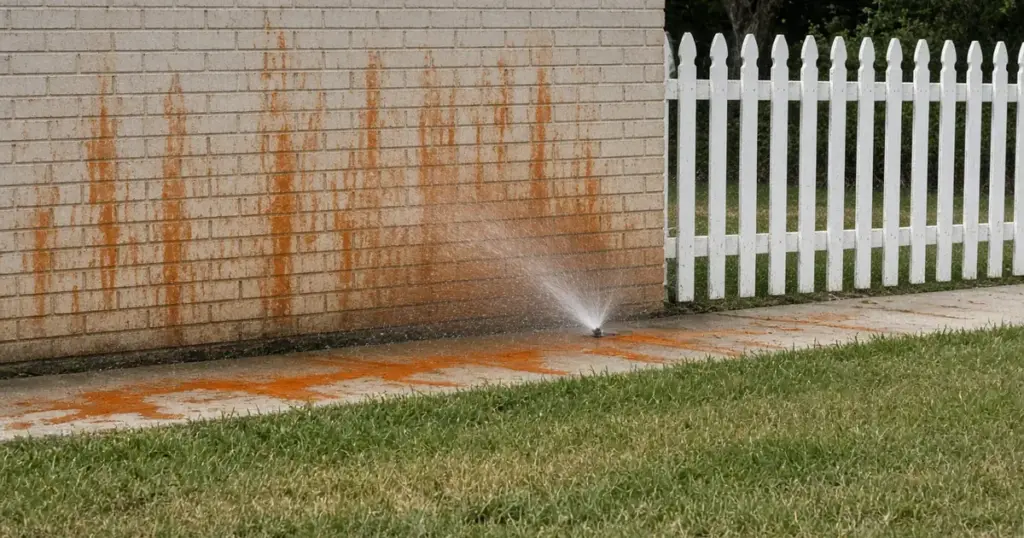
If your sprinklers run on well water and the bottom of your house, the sidewalk, or the fence has turned orange, iron is the likely culprit. Dissolved iron in well water is invisible when it leaves the ground, but once it is sprayed into the air and lands on a surface, it oxidizes and leaves rust-colored stains. Each watering adds another thin layer, and over time the stains become dark and stubborn.
Iron staining is common on well-supplied irrigation systems in many parts of East Texas, including rural properties around Huntsville, TX and across Walker County. The good news is that most of the problem can be reduced with a combination of better aiming, design changes, and, where needed, water treatment. This guide explains the options.
Why Iron Stains Happen
Groundwater often contains dissolved iron, picked up as water moves through soil and rock. In the well and pipes, without much oxygen, the iron stays dissolved. When the water is sprayed into the air and lands on a surface, it reacts with oxygen and forms iron oxide, the same compound as rust. The water evaporates, and the rust stays behind.
Some wells also contain iron bacteria, which can produce slimy deposits in pipes and contribute to clogging. Manganese, often found with iron, can cause darker brown or black stains.
Where Stains Show Up
- Walls and foundations hit by spray.
- Sidewalks, driveways, and patios.
- Fences and decks.
- Vehicles parked near heads.
- Plants with leaves that get sprayed.
If stains appear only in certain spots, those areas are getting water they should not be getting. That points to a coverage problem as much as a water quality problem.
Step 1: Stop Spraying Surfaces
The simplest and most effective step is to keep water off surfaces that stain.
- Adjust arcs and radius so heads water only turf and beds.
- Straighten tilted heads.
- Replace nozzles with patterns that fit the area, such as strip or quarter nozzles along edges.
- Move heads back from walls and hardscape. Texas standards require heads on new installations to be at least 4 inches from hardscape and directed away from it.
- Reduce misting with pressure regulation, since mist drifts onto surfaces.
Our guide to stopping overspray and runoff explains these adjustments in detail.
Step 2: Convert Beds Next to the House
Beds along the foundation are a major source of wall staining because spray heads there almost always hit the house. Converting them to drip irrigation delivers water at the soil line, with no spray to stain the walls. Drip emitters can still clog from iron, so filtration and periodic flushing matter.
Step 3: Consider Water Treatment
If stains continue in areas you cannot avoid spraying, treatment may help. Options vary depending on the iron level, other water chemistry, and system flow:
- Oxidation and filtration systems convert dissolved iron to particles and filter them out before they reach the irrigation system.
- Sequestering agents keep iron in solution so it is less likely to stain, typically injected into the irrigation supply.
- Settling tanks allow oxidized iron to settle before water is pumped to the zones in some setups.
Choosing a treatment approach usually requires a water test and advice from a water treatment professional. Any chemical injection into an irrigation system raises backflow protection requirements, since TCEQ guidance treats irrigation systems with chemical additives as a health hazard that requires a reduced pressure principle assembly where the system connects to potable water. If the system is on a well only, protecting the well from contamination remains important. Our article on private well sprinkler considerations in Walker County covers this.
Step 4: Protect the Irrigation System Itself
Iron does not only stain surfaces. It can also clog nozzles, screens, valves, and drip emitters. Practical steps:
- Install and maintain a filter on the irrigation supply.
- Flush lines periodically.
- Clean nozzles and screens when patterns weaken. See clogged sprinkler nozzles and filter screens.
- Watch valves for sluggish operation caused by deposits.
Our guide to well pumps, pressure tanks, and sprinkler systems covers related well system issues.
Removing Existing Stains
Commercial rust stain removers are available for concrete, siding, and other surfaces. Follow the product directions carefully, test in a small area first, and protect nearby plants and grass. Some products can damage certain surfaces, so check compatibility. Removing stains is worth doing only after you have fixed the cause; otherwise, they come back with the next watering.
Timing and Scheduling
Watering early in the morning reduces evaporation, which means water has more time to soak in and less time to dry on surfaces. That does not stop staining on its own, but combined with good aiming, it helps.
Planning a New System on a Well
If you are installing a new system on a well, plan for iron from the start:
- Test the water before design.
- Keep heads well away from walls and hardscape.
- Use drip for foundation beds and narrow strips.
- Size and install filtration at the start.
- Choose a backflow assembly appropriate for any treatment you plan.
When to Call a Pro
Call a professional if stains keep appearing after adjustments, if nozzles and valves clog frequently, if you want foundation beds converted to drip, or if you are planning water treatment that ties into the irrigation system. An irrigation technician can fix coverage and filtration; a water treatment specialist can address water chemistry. The backflow prevention and testing guide explains protection requirements when treatment is added. Our existing article on well water irrigation systems covers general well considerations. We serve well-supplied properties around Huntsville and across Walker County. See our services page and our sprinkler repair page.
Frequently Asked Questions
Why are my sprinklers leaving orange stains?
Dissolved iron in well water oxidizes when it is sprayed and dries on surfaces, leaving rust-colored stains.
Can I stop iron stains without treating the water?
Often, yes, by keeping spray off walls and hardscape and converting beds along the house to drip.
Does iron in well water damage sprinkler parts?
It can clog nozzles, screens, valves, and drip emitters. A filter and regular cleaning help.
Get Help With Iron Staining
For help reducing iron stains from your sprinklers, call 346-586-6060 or request a visit.