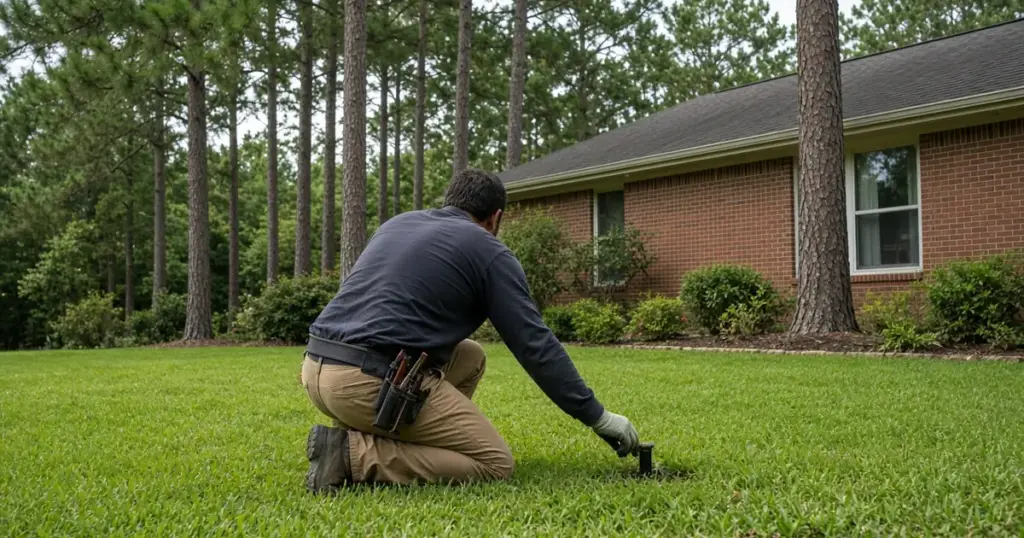
If you own a home in Huntsville, your sprinkler system is working against a particular set of local conditions. Tall pines and old oaks shade many neighborhoods and send roots in every direction. Sandy topsoil sits on a clay layer that changes how water moves. Summers are long and hot, and when the city declares a drought stage, watering days and hours can be limited. All of that shapes which parts fail, how leaks show up, and how a system should be scheduled.
This guide is a local overview for Huntsville homeowners: what tends to go wrong, what the city’s water rules mean for your irrigation, and how to decide what to fix yourself and what to hand off.
What Makes Huntsville Yards Different
Mature trees and roots
Many established neighborhoods near downtown and around Sam Houston State University have large trees that predate the irrigation systems beneath them. Roots grow toward moisture, and a sprinkler line is a reliable source of it. Over time, roots can lift heads out of alignment, crush thin-wall pipe, and crack fittings. Our article on how pine and hardwood roots damage irrigation lines explains the warning signs, such as heads that slowly tilt or a zone that gradually loses pressure.
Shade also changes watering needs. A zone that covers both open lawn and the shade beneath a big oak will either overwater the shade or underwater the sun. That is one of the most common reasons a yard looks patchy despite regular watering.
Sand over clay
Huntsville-area soils often have a sandy loam surface over denser clay. Water from a cracked pipe can travel through the sand and surface somewhere else, or never surface at all. That is why leaks here are often found through pressure changes, meter readings, or a strip of unusually green grass rather than an obvious puddle. See signs your sprinkler system has an underground leak for what to look for.
Heat and heavy summer use
When temperatures climb, systems run longer and more often. Worn seals, tired solenoids, and borderline valves tend to give up in July and August, which is exactly when a dead zone hurts most. A spring inspection catches a lot of those parts before they fail.
City Water and Your Irrigation
The City of Huntsville’s water comes from both treated surface water delivered by the Trinity River Authority and city-owned groundwater wells, according to the city’s Water Conservation and Drought Contingency Plan. A few city rules are worth knowing as an irrigation owner.
Drought stages. The city’s plan sets out staged restrictions. In its published 2019 version, Stage 1 prohibits landscape irrigation between 7:00 AM and 7:00 PM and assigns watering days by address, with hand watering and drip allowed at any time; later stages tighten further. Always check the City of Huntsville water page for the current plan and whether a stage is active.
Backflow responsibility. Under the city’s utility service agreement, the customer is responsible for installing, testing, and maintaining any backflow prevention device the city requires, and for providing test records. Our backflow prevention and testing guide explains assembly types and testing.
No irrigation wells in city limits. The city’s Unified Development Ordinance states that irrigation water supply wells are prohibited within city limits. If you are thinking about a well to cut your water bill, that rule matters.
The Repairs Huntsville Homes Need Most
Based on the conditions above, these are the problems that come up most often around town:
- Broken or tilted heads from mowers, roots, and settling soil.
- Clogged nozzles and filter screens from sand and pipe debris.
- Lateral line leaks caused by roots, shifting soil, or old fittings.
- Valve problems, such as zones that will not turn on or will not shut off, often from debris or worn diaphragms.
- Wiring faults from landscaping projects, fence posts, and corrosion.
- Backflow assembly damage after hard freezes.
- Controller issues after storms and power outages.
The complete sprinkler troubleshooting guide walks through how to diagnose each by symptom.
A Seasonal Rhythm That Works Here
- Spring: Full inspection, controller update, rain sensor test, leak check.
- Summer: Water early, use cycle-and-soak on slopes and clay, walk zones every couple of weeks.
- Fall: Cut run times as temperatures drop; St. Augustine lawns in particular do not want to stay wet in cool weather.
- Winter: Insulate the backflow assembly before hard freezes and turn off automatic watering on freezing nights.
DIY or Professional?
Plenty of small jobs are reasonable for a homeowner: cleaning nozzles, adjusting spray direction, raising a sunken head, and resetting the controller. Others are better handed off because they involve the water supply, hidden faults, or licensing requirements. In Texas, irrigation work done for someone else must be performed by or under a TCEQ-licensed irrigator, and backflow testing requires a licensed tester.
When to Call a Pro
Call for help when water runs continuously and you cannot stop it, when you see water near the backflow assembly or main line, when a zone stays dead after basic checks, when you suspect a leak you cannot find, or when the backflow assembly needs testing or repair. We serve homeowners across Huntsville and the rest of Walker County. See our sprinkler repair page for the repairs we handle and our service areas page for the communities we cover. Neighboring towns are covered in the guide to Huntsville and the surrounding East Texas towns.
Frequently Asked Questions
Do Huntsville drought restrictions apply to drip irrigation?
In the city’s published 2019 plan, Stage 1 allows watering with a handheld hose or drip irrigation at any time, while later stages are more restrictive. Check the city’s current plan when a stage is declared.
Who is responsible for backflow testing at my house?
Under the city’s service agreement, the customer is responsible for installing, testing, and maintaining required backflow devices. A licensed tester performs the test and submits the results.
Can I drill a well to water my lawn inside city limits?
The city’s development ordinance prohibits irrigation water supply wells within city limits. Properties outside the city may have different options.
How do I know if my sprinkler problem is urgent?
Running water you cannot shut off, water near the foundation, and a damaged backflow assembly are urgent. Most other problems can wait for a scheduled visit.
Get Sprinkler Help in Huntsville
From a single broken head to a system-wide tune-up, we can help. Call 346-586-6060 or request service online, and we will get your Huntsville yard watering properly again.