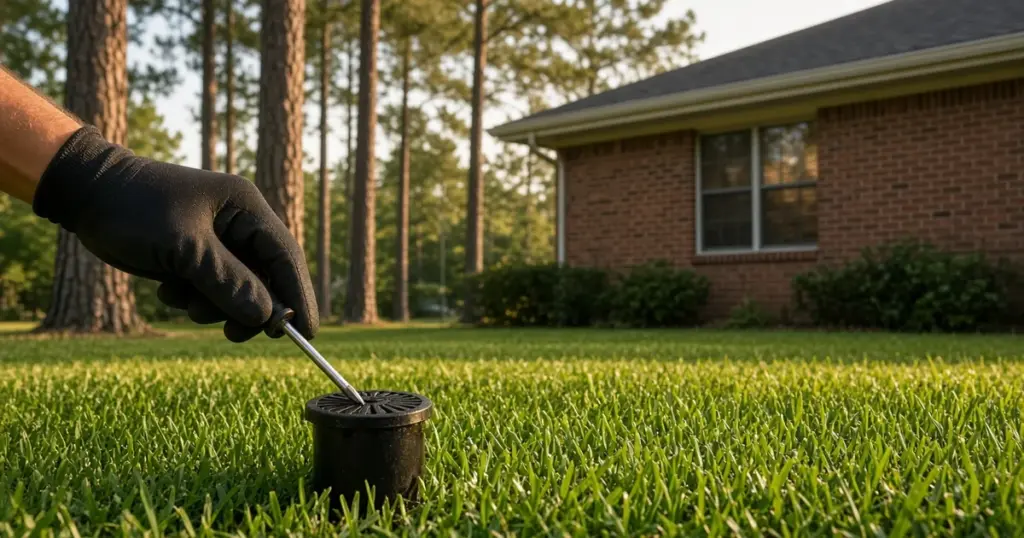
Most sprinkler problems announce themselves in small ways long before they turn into a soggy yard or a dead lawn. A head that rises halfway, a zone that sounds different, a strip of grass that browns in the same place every July: each is a clue. This guide organizes the most common sprinkler failures by the symptom you actually see, so you can narrow down the cause before you start digging or spending money.
It is written for homeowners in Huntsville, TX and the rest of Walker County, where irrigation systems deal with a specific set of local conditions: long, hot summers, sandy loam topsoil sitting on dense clay, pine and oak roots, and the occasional hard freeze. Those conditions shape what breaks and how often.
Start With the Right Question: Is It One Head, One Zone, or Everything?
Before you look at any single part, figure out how widespread the problem is. That one observation eliminates most of the possible causes.
- One head misbehaving usually means a problem at that head: debris in the nozzle, a cracked body, a worn wiper seal, or a broken riser.
- One whole zone misbehaving points upstream to the valve, the solenoid, the wiring for that station, or a break in that zone’s lateral pipe.
- Every zone misbehaving points to something shared: the controller, the power supply, the master valve, the backflow assembly, or the water supply itself.
Run each zone manually from the controller and walk the yard while it runs. Watch for heads that do not rise, sprays that fog instead of throwing droplets, geysers, puddles, and sections that never get wet. Write down what you see by zone number. A two-minute walk with a notepad gives you a better diagnosis than an hour of guessing.
Problems at the Sprinkler Head
Heads that stay down or rise only partway
A pop-up that stays buried or stalls halfway is one of the most common sprinkler complaints. The usual suspects are grit packed around the riser, a worn seal, low pressure in that zone, or a head that has sunk below grade as soil settled. Our guide on sprinkler heads that won’t pop up walks through how to tell those causes apart. If the head sits too low or too high compared with the lawn, why sprinkler head height matters explains how grade affects coverage.
Cracked or broken heads
Mowers, edgers, trucks, and freezes all break heads. A broken head often shows up as a geyser or a bubbling puddle and a weak spray everywhere else on the zone. Replacing one is a reasonable DIY job if you match the brand, pop-up height, and nozzle correctly. We cover the process, including the mistakes that turn a simple swap into a pipe repair, in how to replace a broken sprinkler head. If the same heads keep getting broken, the article on mower and vehicle damage to sprinkler heads covers prevention.
Spray hitting the wrong place
Water on the driveway, the siding, or the street is wasted water, and in many cases it is a simple adjustment. Spray nozzles and rotors both have settings for arc and radius. See how to adjust sprinkler heads for the specific steps for each head type.
Weak, sputtering, or uneven spray
When one head dribbles while its neighbors throw a full pattern, the nozzle or the small filter screen under it is often clogged with sand or pipe debris. Cleaning those is covered in clogged sprinkler nozzles and filter screens. If the problem is a gear-driven rotor that sprays but does not turn, read rotor sprinkler head not rotating.
Problems Across a Whole Zone
Low pressure on a single zone
If a single zone runs weak while the others are fine, think about a partially closed flow control on the valve, a leak on that zone’s pipe, or too many heads on one circuit. Our existing article on common causes of low sprinkler pressure is a good next stop, and the sprinkler leak repair guide explains how to confirm whether a hidden break is stealing water.
Too much pressure
The opposite problem is just as real. When pressure is too high, spray heads produce a fine mist that drifts away in the wind and evaporates before it reaches the roots. The guide to sprinklers misting from high water pressure covers pressure-regulated heads and other fixes.
A zone that will not start or will not stop
These are almost always valve or wiring problems. Our existing posts on why one sprinkler zone will not turn on and a zone that will not shut off cover the basics, and the sprinkler valves and wiring guide goes deeper into solenoids, diaphragms, and splices.
Banging or knocking when a zone closes
A sharp bang in the pipes when a zone shuts off is water hammer. It is more than a noise; repeated shock can loosen fittings and crack older pipe. The article on water hammer and banging pipes explains why it happens and what can be done.
Problems With the Entire System
If nothing runs at all, start at the controller and work outward: power, display, programming, rain sensor, common wire, master valve, and water supply. Our step-by-step diagnosis for a whole system that won’t turn on lays out that sequence. Controller programming questions are covered in the sprinkler controllers and smart irrigation guide.
A Simple Troubleshooting Routine You Can Repeat
You do not need special tools for a basic system check. Once a month during the growing season, try this routine:
- Check the controller display for error messages, the correct date and time, and whether a rain delay is active.
- Run each zone manually for two or three minutes.
- Walk each zone while it runs and look at every head: does it rise fully, spray the right direction, and seat back down when the zone stops?
- Look for puddles, soft spots, or water bubbling up between heads.
- Listen at the valve box for hissing or chattering when the zone is off.
- Note anything odd by zone number and fix the simple items first.
This routine catches most issues while they are still cheap. It also gives you useful details if you do end up calling for help, which shortens the visit.
Local Conditions That Make Some Problems More Common
In Huntsville and across Walker County, a few patterns show up again and again. Sandy topsoil works its way into heads and valves, so clogged nozzles and stuck risers are common. The clay layer below can hold water around a leak instead of letting it drain, which sometimes makes a break show up as a mushy spot far from the actual crack. Pine and oak roots lift and crush pipe over time. And summer heat pushes systems to run longer and more often, so worn parts fail during the hottest weeks of the year, when you least want a dead zone. The year-round sprinkler maintenance calendar explains when to check for each of these.
When to Call a Pro
DIY troubleshooting is worth trying for clogged nozzles, adjustments, and single-head swaps. It is time to call a professional when:
- Water is running continuously and you cannot shut it off at the controller or the valve.
- You see water coming up near the backflow assembly, the main line, or the house foundation.
- A zone has stopped working and the solenoid and wiring checks have not found the cause.
- Multiple zones have problems at once, which often points to a main-line or controller issue.
- You suspect a leak but cannot find the wet spot.
Our sprinkler repair service handles everything from single heads to valve rebuilds, and if water is flowing where it should not be, emergency service is the faster route.
Frequently Asked Questions
How do I know if my problem is the valve or the controller?
Try running the zone manually at the valve using the bleed screw or solenoid twist. If the zone runs from the valve but not from the controller, the problem is electrical: wiring, the solenoid, or the controller. If it will not run even manually, the valve itself or the water supply is the likely cause.
Is it normal for a little water to leak from heads after the system stops?
A small amount of drainage from the lowest head on a zone can be normal on sloped yards. It is called low-head drainage, and check valves in the heads can reduce it. A continuous trickle that never stops is not normal and usually points to a valve that is not closing fully.
How often should a sprinkler system be inspected?
Many homeowners in Walker County benefit from a professional check at least once a year, ideally in spring before the heavy watering season. A quick monthly walk-through of each zone in summer catches small problems between visits.
Can I fix most sprinkler problems myself?
Many head-level problems are manageable for a handy homeowner. Valve diagnosis, wiring faults, main-line leaks, and backflow assembly repairs are better left to a licensed irrigator.
Get Help With a Sprinkler Problem
If you have worked through the checks above and the problem is still there, we can take it from here. Call 346-586-6060 to talk with our Huntsville team, or send us a service request with your zone notes, and we will help you get the system running the way it should.