If you have received a notice that your irrigation backflow assembly is due for testing, or you just had a new system installed, you may be wondering what the test actually involves. It is a short, specialized procedure, and knowing what to expect makes it easier to schedule, prepare for, and understand the results.
This article explains who can perform a backflow test in Texas, what the tester does at each step, what the results mean, and how testing fits into the requirements for properties in Huntsville, TX and across Walker County.
Why Backflow Assemblies Need Testing
A backflow prevention assembly is a mechanical device with springs, rubber seals, and moving parts. It can look fine from the outside while a check valve inside is fouled with debris or a seal has worn out. The only way to know it will actually stop backflow is to measure how it performs under controlled conditions.
The Texas Commission on Environmental Quality requires testing by a licensed tester when an assembly is installed, and its cross-connection control page notes that water providers may require annual tests on irrigation assemblies. Assemblies protecting against health hazards must be tested annually under state rules. Your water provider’s requirements are the ones you need to follow, and many providers set an annual schedule.
Who Can Perform the Test
Only a TCEQ-licensed Backflow Prevention Assembly Tester (BPAT) can test and repair these assemblies. The tester uses a calibrated differential pressure test kit and records results on a standard report form. TCEQ publishes a Backflow Prevention Assembly Test and Maintenance Report form for this purpose.
Within the City of Huntsville, the city has used an online system for registered testers to submit results. If you are inside city limits, a tester familiar with the city’s process will handle that submission.
Before the Tester Arrives
A little preparation makes the visit faster:
- Make sure the assembly is accessible. Clear plants, mulch, insulation covers, and anything stored around it.
- Know where the irrigation shutoff valves are. The tester will need to close them.
- Expect a short water interruption to irrigation. The test does not usually affect household water, but irrigation will be off while it is performed.
- Have previous test reports handy if you have them. They can help spot recurring issues.
What Happens During the Test
The exact procedure depends on the type of assembly, but the general steps are similar.
1. Visual inspection
The tester checks the assembly for physical damage, leaks, correct orientation, proper clearance, and correct installation height. For a pressure vacuum breaker, the device has to sit above the highest downstream head.
2. Shutting the assembly down
The tester closes the shutoff valves that are part of the assembly, isolating it so the internal parts can be tested without water flowing through to the irrigation system.
3. Connecting the test kit
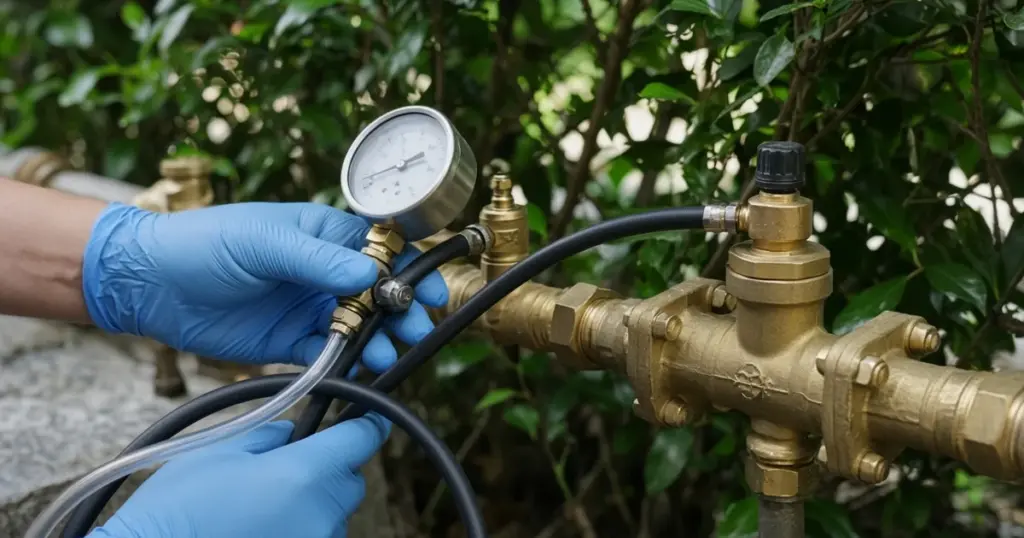
Hoses from the differential pressure gauge attach to the assembly’s test cocks, the small valves on the side of the body. Each test cock gives access to a different chamber of the assembly.
4. Testing each component
The tester measures how each internal part holds pressure:
- Check valves are tested to confirm they hold tight and maintain the required pressure difference.
- The relief valve on a reduced pressure zone (RPZ) assembly is tested to confirm it opens at the right point to dump water if a check fails.
- The air inlet on a pressure vacuum breaker is tested to confirm it opens when pressure drops.
The readings are compared against minimum values in the standard test procedure for that type of assembly.
5. Restoring service
The tester disconnects the gauge, closes the test cocks, reopens the shutoff valves, and checks that the assembly is not leaking. Irrigation is then back in service.
6. Reporting
The tester completes the test report and submits it as your water provider requires. For new installations, state rules call for results to be provided to the water provider and the owner within ten business days.
For an overview of assembly types and how they differ, see the backflow prevention and testing guide.
Understanding the Results
Pass: Every component met the minimum values. The assembly is good until the next required test, assuming no repairs or relocation in the meantime.
Fail: At least one component did not hold. Common causes include debris on a check seat, worn rubber parts, a weak spring, or freeze damage. A failure does not automatically mean replacement; often the assembly can be cleaned or rebuilt and retested. Our earlier post on backflow preventer problems in Huntsville covers the warning signs that often show up before a failed test.
Common Issues Testers Find in This Area
- Sand and grit on check seats, which is common with sandy local soils and after line repairs.
- Freeze damage to above-ground assemblies, such as cracked bonnets or bodies. Our existing article on protecting irrigation and backflow from freezes explains how to prevent it.
- Worn seals and springs on older assemblies.
- Installation problems, such as a PVB installed lower than the highest head.
How Long Does It Take?
A routine test on an accessible, working assembly is typically short. Repairs and retests, if needed, take longer. Overgrown or buried assemblies add time.
When to Call a Pro
You need a licensed tester for any test, and a licensed professional for repairs. Call promptly if water is dripping or spraying from the assembly, if an RPZ relief valve is discharging, if the assembly was damaged by a freeze or a vehicle, or if you have received a testing notice from your water provider. After a repair or relocation, the assembly must be tested again before going back into normal service. Our services page covers backflow testing and related work, and our sprinkler repair page covers repairs elsewhere in the system. Other routine checks are listed in the year-round maintenance calendar.
Frequently Asked Questions
Will my household water be shut off during the test?
Usually only the irrigation side is affected, since the assembly serving the sprinklers is isolated during the test. If the assembly protects the whole property, the tester will explain any interruption beforehand.
How often do I need a backflow test?
At minimum when the assembly is installed, repaired, replaced, or relocated, and annually for health-hazard applications. Many water providers require annual tests for all irrigation assemblies.
What happens if I skip a required test?
Water providers can enforce their cross-connection programs, which may include notices and, in some cases, service actions. Check your provider’s requirements and schedule tests on time.
Schedule Your Backflow Test
If your assembly is due for testing or you have questions about a notice, call 346-586-6060 or request service online. We help property owners throughout Huntsville and Walker County keep their backflow assemblies tested and working.