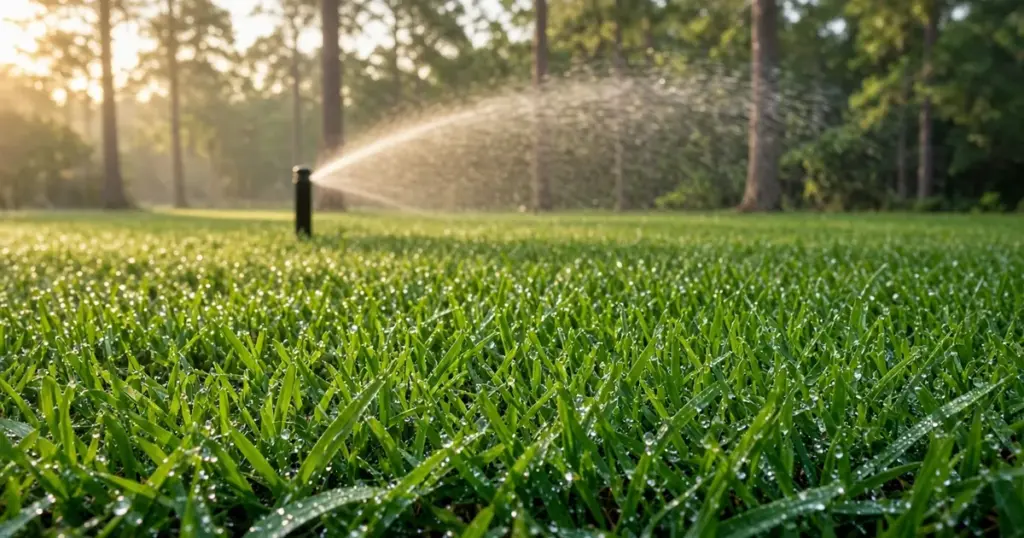
St. Augustine is the lawn grass you see in front of a large share of East Texas homes, and for good reason. It handles heat, tolerates more shade than many warm-season grasses, and forms a thick carpet that crowds out weeds. But it is also the grass most likely to suffer from the wrong watering habits. Too little water in July and it thins out; too much in October and fungus moves in.
This guide covers how to water St. Augustine in the conditions found around Huntsville, TX and Walker County: hot summers, humid air, shade from pines and oaks, and sandy topsoil over clay.
What St. Augustine Needs
St. Augustine spreads by above-ground runners called stolons and has broad, coarse blades. It does best with:
- Deep, infrequent watering that wets the full root zone and then lets the surface dry somewhat.
- Morning watering so blades dry during the day.
- Partial to full sun, though it tolerates more shade than Bermuda.
- Mowing at a higher height than fine-textured grasses, which helps it shade its own roots.
It does not recover from severe drought as readily as Bermuda, so it is worth paying attention during long dry spells.
Signs St. Augustine Needs Water
Rather than watering on a rigid schedule, learn to read the lawn:
- Blades fold or roll lengthwise. This is one of the earliest signs of water stress.
- Color shifts to a dull blue-gray.
- Footprints stay visible after you walk across the lawn instead of springing back.
- The soil is dry several inches down when you push a screwdriver or probe into it.
If you see these signs across a section of lawn, it is time to water that zone. If you see them in one spot only, check sprinkler coverage first. Our existing post on preventing lawn brown spots covers how to spot coverage problems.
How Much and How Often
There is no fixed number that fits every St. Augustine lawn. Many turf guides use about an inch of water per week in peak summer, including rain, as a starting point, then adjust based on soil and weather. In practice:
- Measure your system’s output with a catch-cup test so you know how long it takes to apply a given depth.
- Water to the depth of the roots, not just the surface. Probe the soil an hour after watering to see how far water reached.
- Use cycle-and-soak on clay and slopes. Sandy loam on top absorbs water quickly, but the clay below slows it. Splitting a long run into two or three shorter cycles with breaks lets water soak in rather than running off.
- Adjust seasonally. St. Augustine needs much less water in spring and fall than in July and August.
Our post on watering your Huntsville lawn through humidity and fungus season covers schedules in more depth.
Shade Zones Need Different Settings
St. Augustine is often the grass of choice under trees, but shaded turf uses less water than turf in full sun. A zone that covers both will overwater the shade or underwater the sun. If your system allows, put shaded areas on their own zone with shorter run times. Tree roots also compete for water, so shaded St. Augustine sometimes looks thin for reasons that have nothing to do with irrigation.
Disease: The Cost of Overwatering
St. Augustine’s biggest weakness is fungal disease, and water management is one of the best ways to prevent it.
Large patch
Large patch typically appears in fall and spring when temperatures are mild and turf stays wet. It shows up as circular patches of yellow to brown grass that expand outward. Overwatering and evening watering make it worse. As temperatures drop in fall, cut back watering. Our article on fall sprinkler adjustments explains how.
Gray leaf spot
Gray leaf spot tends to appear in hot, humid summer weather, especially on lush, heavily fertilized turf. Avoiding prolonged leaf wetness and excessive nitrogen helps.
Watering habits that reduce disease
- Water in the early morning, never in the evening.
- Avoid daily light watering, which keeps the surface constantly wet.
- Fix leaks and low-head drainage that keep spots soggy.
- Skip cycles after rain.
Chinch Bugs: Damage That Looks Like Drought
In hot, sunny areas, especially near driveways and sidewalks where heat builds, chinch bugs can cause patches of yellowing, then browning St. Augustine that look exactly like drought stress. Watering more will not fix it. If a sunny patch keeps browning despite good coverage and moist soil, check closely at the base of the grass for small insects, or have the lawn looked at by a turf professional. Separating irrigation problems from pest problems saves water and frustration.
Keeping the System Matched to the Grass
Even perfect scheduling cannot overcome a system that applies water unevenly. Check that:
- Heads are at the right height and not buried by thick St. Augustine runners.
- Spray patterns overlap head to head.
- Pressure is in the right range so heads do not mist.
- Shade and sun areas are zoned separately where possible.
The lawn and soil irrigation guide covers how grass type and soil interact with system design, and the sprinkler troubleshooting guide covers coverage problems by symptom.
When to Call a Pro
If your St. Augustine has dry patches in the same spots every summer, soggy areas that never dry out, or a zone that seems to water both shade and sun poorly, the problem may be in the system rather than the schedule. A professional coverage check can find mismatched heads, poor spacing, or pressure problems, and re-zoning can separate shade from sun. See our sprinkler repair page for adjustments and repairs, and our irrigation installation page for re-zoning and upgrades.
Frequently Asked Questions
Should I water St. Augustine every day in summer?
Usually not. Daily light watering keeps roots shallow and the surface wet, which encourages disease. Deeper, less frequent watering works better for most lawns.
Why does my St. Augustine turn brown near the driveway?
Heat reflected from pavement increases water demand, and those areas are also where chinch bugs often show up. Check coverage first, then look for insects if the soil is moist but the grass keeps declining.
Can St. Augustine survive a drought?
It can survive dry periods, but it does not bounce back as easily as Bermuda. During long dry spells, keep watering enough to prevent severe stress, while following any local watering restrictions.
Get Help With Your Lawn’s Irrigation
If your St. Augustine lawn is struggling despite regular watering, call 346-586-6060 or request a coverage check. We help homeowners across Huntsville and Walker County get water where their lawns need it.