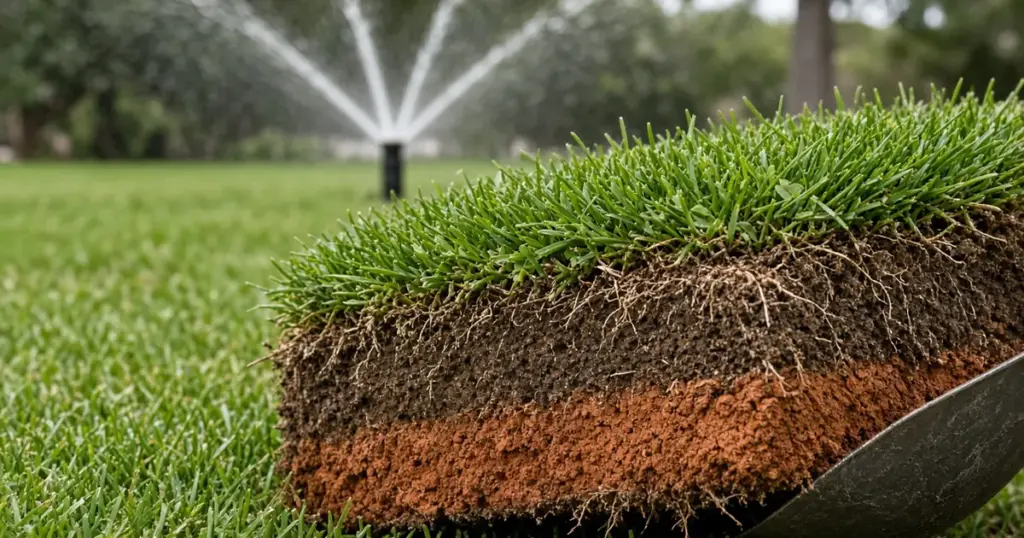
Two lawns on the same street can need very different amounts of water. One might be shaded St. Augustine growing over a deep sandy layer; the other might be sun-baked Bermuda on a thin layer of topsoil over clay. Give them the same schedule and at least one of them will struggle.
Good irrigation starts with understanding what you are growing and what it is growing in. This guide covers the main warm-season grasses found in Huntsville, TX yards, the layered soils typical of Walker County, and how both should shape the way you set your sprinkler system. Each section links to a more detailed article.
The Soil Under Your Lawn
Sandy loam over clay
Many yards in this area have a surface layer of sandy loam that drains and warms quickly, sitting on top of denser clay that holds water and drains slowly. That combination creates a few predictable patterns:
- Water soaks in fast at first, then slows down sharply when it reaches the clay.
- On slopes, water can move sideways along the top of the clay and come out lower in the yard.
- Roots may stay shallow if the sandy layer is thin, which makes the lawn more drought-sensitive.
Our detailed post on irrigating sandy loam over clay explains how to schedule for this profile, including cycle-and-soak timing.
Compaction
Construction traffic, vehicles, and years of foot traffic compact soil, so water runs off before it can soak in. Core aeration helps, but aerating a lawn with a sprinkler system takes some care. See lawn aeration and sprinkler systems before you rent a machine or hire a crew.
How to check your own soil
You do not need a lab to learn a lot. After a normal watering, push a long screwdriver or soil probe into the lawn. Where it slides in easily, water has reached. Where it stops, you have hit dry soil or the clay layer. Dig a small hole with a trowel in a few spots and look at the layers. That simple test tells you how deep water is reaching and whether your run times are too short or too long.
Grass Types Common in Local Yards
St. Augustine
St. Augustine is the most common lawn grass in many East Texas neighborhoods. It tolerates more shade than Bermuda and forms a thick, coarse turf. It also has real weaknesses: it is prone to fungal disease when kept too wet, especially in cool, damp fall weather, and it does not recover from drought as readily as Bermuda. Our guide on how to water St. Augustine grass in East Texas covers schedules and disease prevention.
Bermuda
Bermuda grass loves full sun and heat, spreads aggressively, and recovers well from stress. It handles drought by going dormant and greening back up when water returns. It does not do well in shade. See watering Bermuda grass for deep, infrequent watering strategies.
Zoysia
Zoysia forms a dense, fine to medium-textured lawn with moderate shade tolerance depending on the variety. It grows slowly, which means it is slow to recover from damage and prone to thatch if overwatered and overfertilized. How to irrigate Zoysia grass explains how to avoid those problems.
Winter ryegrass
Some homeowners overseed dormant Bermuda with ryegrass for winter color. That changes the fall and winter irrigation picture completely, because the new seed needs frequent light watering to establish. See overseeding with ryegrass.
Special Situations
Shade and trees
Shaded lawns lose less water to evaporation, but tree roots compete for every drop. Lawns under pines and oaks often need different run times than sunny areas, and ideally a separate zone. We cover the details in watering shady lawns under pines and oaks. If you have mature trees near your irrigation lines, how pine and hardwood roots damage irrigation lines is also worth a read.
New sod
Fresh sod has almost no root system, so it needs frequent watering at first and then a gradual transition to a normal schedule. Getting that transition right is the difference between a lawn that roots deeply and one that stays dependent on daily water. See our new sod watering schedule.
Brown spots and uneven color
When one area browns while the rest of the lawn looks fine, the cause is often uneven coverage rather than a lack of water overall. Our earlier article on preventing lawn brown spots covers coverage checks and fixes.
Principles That Apply to Every Lawn
- Water deeply and less often. Deep watering encourages deeper roots. Frequent shallow watering keeps roots near the surface.
- Water in the early morning. This limits evaporation and lets grass blades dry during the day, which matters in our humid climate.
- Match zones to conditions. Sun and shade, lawn and beds, slope and flat ground should not share a zone if you can avoid it.
- Watch the lawn, not just the calendar. Grass that holds a footprint, takes on a blue-gray tint, or curls its blades is asking for water. Grass that stays soggy or grows mushrooms is getting too much.
- Adjust seasonally. Warm-season grasses need far less water in fall and winter. The year-round maintenance calendar shows when to change your schedule.
- Check your output. A catch-cup test shows how much water each zone actually applies, which takes the guesswork out of run times. The efficient irrigation guide explains how to use those numbers.
When to Call a Pro
If you have adjusted schedules and still see dry patches, soggy areas, or disease that keeps coming back, the problem may be in the system rather than the schedule. Mismatched heads, poor spacing, low pressure, or a lawn zone that also waters a shaded bed can all make a lawn look like it has a grass problem when it really has an irrigation problem. A professional can check coverage, pressure, and zoning and recommend fixes. See our sprinkler repair page for adjustments and repairs, or the irrigation installation page if your yard needs re-zoning or new heads.
Frequently Asked Questions
How much water does a lawn need in Huntsville?
It depends on the grass, the soil, the season, and the weather. Rather than a fixed number, use soil probing and the lawn’s appearance as guides, and measure what your system applies with a catch-cup test.
Which grass uses the least water?
Bermuda tends to handle drought well by going dormant and recovering, but it needs full sun. The best choice depends on how much shade you have and how you use the yard.
Should my lawn and flower beds be on the same zone?
Ideally, no. Turf and beds have different water needs, and beds are often better served by drip irrigation on their own zone.
Get Your Lawn and System Working Together
If your lawn is struggling despite regular watering, we can check coverage and recommend adjustments that suit your grass and soil. Call 346-586-6060 or book a visit online for help anywhere in Huntsville and Walker County.