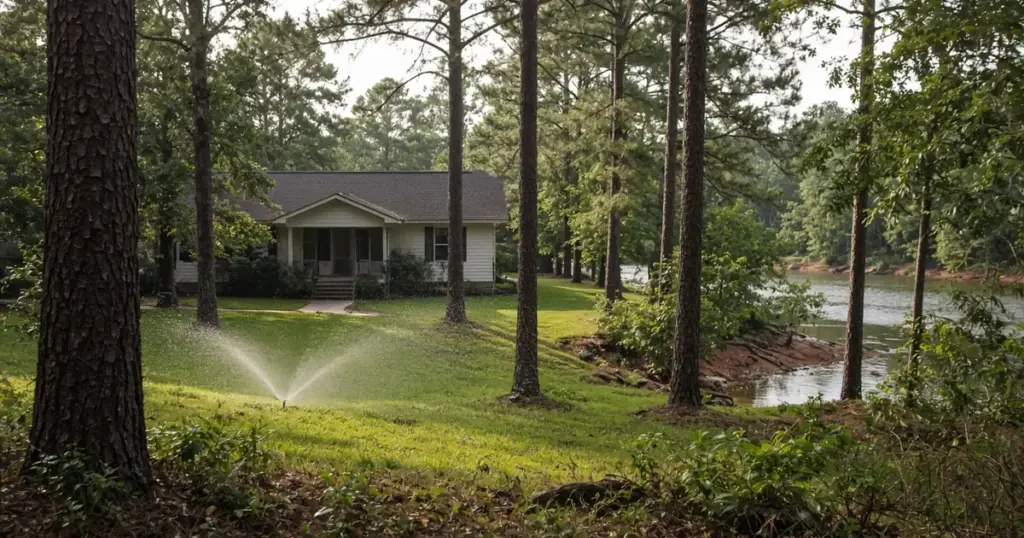
Pointblank is a small San Jacinto County community near the southwestern side of Lake Livingston, southeast of Huntsville. Many properties here are lake homes, weekend places, and rural lots tucked into the pines. Irrigation systems in the area tend to be smaller residential systems, sometimes on wells, sometimes on public water, often watched over by owners who are not there every day.
We provide sprinkler and irrigation repair in Pointblank as part of our service area around Huntsville, TX and Walker County. This guide covers what to expect from local conditions, what tends to break, and how to keep a system reliable when you are not around to watch it.
Local Conditions
Lake influence
Properties near the water often have sandy soils, slopes toward the shoreline, and steady breezes off the lake. Sandy soil drains fast, slopes shed water, and wind distorts spray. All three affect how much water reaches the lawn and how evenly.
Pines and shade
Tall pines shade lawns, drop needles into heads and valve boxes, and send roots toward moist soil around irrigation lines.
Part-time use
Many lake homes are occupied on weekends or seasonally. A head broken by a mower or a valve stuck open can run for days before anyone sees it.
Water source
Some homes use wells, others connect to public water systems. The water source affects pressure, filtration needs, and backflow requirements. Our existing article on well water irrigation systems covers well-specific issues.
Common Repairs
- Broken heads from mowing and settling in sandy soil.
- Clogged nozzles from needles, sand, or well sediment.
- Leaks from roots or shifting soil on slopes.
- Valves that stick open or closed.
- Controller resets after storms and outages.
- Freeze damage to backflow assemblies and exposed pipe.
- Backflow assembly repair and testing.
Our homeowner’s guide to sprinkler repair explains how each repair is handled.
Keeping a Part-Time System Reliable
- Use a smart controller so you can check and adjust watering remotely.
- Add a flow sensor and master valve to detect and stop leaks automatically.
- Do a pre-departure check: run each zone, look for problems, and confirm the rain sensor works.
- Close the irrigation supply during long absences in winter.
- Ask a neighbor to report water running in the yard.
Lakeside Watering Tips
- Water early in the morning, before the wind picks up.
- Use cycle-and-soak on slopes to reduce runoff toward the lake.
- Consider rotary nozzles, which apply water more slowly and resist wind better than standard sprays.
- Keep heads aimed away from docks, walks, and the shoreline.
- Separate sun and shade areas into different zones where possible.
Backflow and Septic Systems
Many lake homes use septic systems. TCEQ guidance calls for a reduced pressure principle assembly when a property has an on-site sewage facility and the irrigation system is connected to potable water. All backflow assemblies must be tested by a licensed tester after installation, repair, replacement, or relocation, and your water provider may require periodic tests.
Seasonal Notes
Spring
Inspect after winter, clear debris from heads and valve boxes, and set the schedule for warming weather.
Summer
Watch for dry spots in sandy areas and runoff on slopes. Check after storms.
Fall
Reduce watering as temperatures drop and needles fall.
Winter
Protect the backflow assembly and exposed pipe before hard freezes, and consider shutting the system down if the home will be empty.
Equipment That Holds Up at the Lake
Lake properties put equipment through a lot: wind, sun, sandy soil, and long periods without attention. A few choices help systems last:
- Heads with check valves stop water from draining out of low heads on slopes.
- Sturdy valve box lids keep out needles, sand, and animals.
- Insulated covers protect the backflow assembly in winter.
- A controller in a protected location avoids damage from heat and storms.
- A filter on well-supplied systems keeps sand out of valves and nozzles.
Upgrades like these can be made a little at a time, often during routine repairs.
A Simple Yearly Routine
Once a year, ideally in spring, have every zone run while someone walks the property. Clean or replace clogged nozzles, straighten tilted heads, clear valve boxes, test the rain sensor, and review the schedule. A routine like that catches most problems before they cost you a weekend.
Nearby Communities
Pointblank owners often have ties to Coldspring, Onalaska, and other lake communities. See our pages on sprinkler repair in Coldspring and sprinkler repair in Onalaska. For more lake-specific advice, read irrigation for Lake Livingston properties.
Getting Ready for a Visit
If you will not be on site for a repair, a little preparation keeps things moving: share gate codes or access instructions, note where the controller and backflow assembly are, unlock any enclosures, and describe what you or a neighbor observed. Photos of problem areas are helpful. After the visit, you get a summary of what was found and fixed so you know the system is ready for your next stay.
When to Call a Pro
Call us if water is running when the system should be off, if a zone will not turn on or shut off, if the controller lost its programs, if heads clog repeatedly, or if freeze damage is suspected. For part-time homes, a pre-season inspection is a practical way to avoid surprises. Check our service areas page and our sprinkler repair page. The East Texas service area guide covers the full region.
Frequently Asked Questions
Can you service my lake house when I am not there?
In many cases, yes, as long as we can access the controller, valves, and backflow assembly. Call to arrange details.
Why is my lake lawn dry even though the sprinklers run?
Sandy soil, wind, and slopes all reduce how much water stays in the root zone. Adjusting nozzles and schedules usually helps.
Do I need a special backflow preventer if I have a septic system?
TCEQ guidance calls for a reduced pressure principle assembly when irrigation is connected to potable water on a property with an on-site sewage facility.
Schedule Service in Pointblank
Call 346-586-6060 or request service for your Pointblank property.