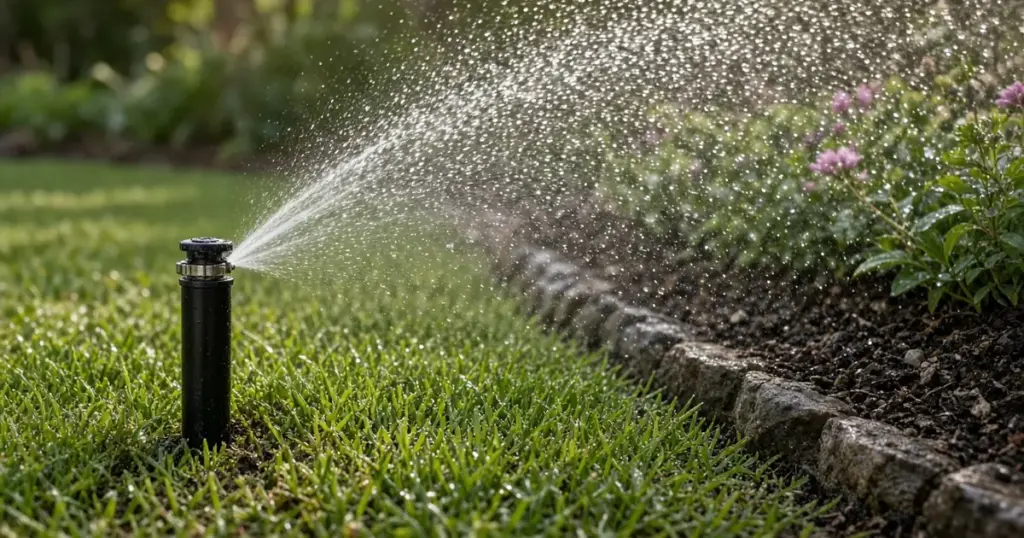
Sprinkler heads are designed to work best within a certain pressure range. Give a spray head too little pressure and it dribbles. Give it too much and the water breaks into a fine mist that drifts in the wind, evaporates before it lands, and leaves the area the head is supposed to cover unevenly watered. High pressure is a common and often overlooked cause of waste.
Pressure-regulating heads have a built-in regulator that reduces the pressure reaching the nozzle to a set level. They are one of the simplest upgrades available, and on systems with high pressure, they can make a noticeable difference. This guide explains how they work, how to tell if you need them, and where they make the most sense for homes in Huntsville, TX and Walker County.
How Pressure Affects Spray
When pressure is right, a spray nozzle forms well-defined droplets that travel to the edge of the pattern and land evenly. As pressure climbs above the recommended range:
- Droplets get smaller, turning into mist.
- Wind carries mist off target.
- Evaporation increases.
- Coverage becomes uneven, with dry spots between heads.
- Water use rises, because nozzles flow more at higher pressure.
Our article on sprinkler misting from high water pressure explains the symptoms in more detail.
How Pressure-Regulating Heads Work
A regulating head contains a small regulator in the stem or body. Water enters at system pressure, passes through the regulator, and reaches the nozzle at a lower, controlled pressure. The rated pressure varies by product and by head type, with spray heads and rotors typically regulated to different levels.
Some products put the regulator in the nozzle or in a fitting under the head. Others regulate the whole zone with a regulator at the valve.
Signs You May Need Them
- Visible mist or fog around heads.
- Spray drifting onto walks and walls even on calm days.
- Dry spots between heads despite long run times.
- Very high readings on a pressure gauge.
- Heads that “pop” or spit when the zone starts.
A pressure gauge that screws onto a hose bib or a test fitting gives a quick reading of static pressure. Pressure at the heads during operation is lower than static pressure because of losses in pipe and fittings. A technician can measure pressure at a head with a pitot gauge or a head-mounted gauge.
Where They Help Most
- Zones close to the water source, which see the highest pressure.
- Low areas where elevation adds pressure.
- Zones with few heads, where there is little pressure loss.
- Spray zones near walks, drives, and windows, where drift causes problems. Our guide to stopping overspray and runoff covers related fixes.
Properties on hills or with sloped yards often see different pressure at the top and bottom of the same zone. Regulating heads even that out because each head controls its own pressure regardless of elevation.
Where They Help Less
- Systems with low pressure, where regulation does nothing useful and the real problem may be a leak, undersized pipe, or too many heads per zone. Our existing post on common causes of low sprinkler pressure covers that problem.
- Drip zones, which need their own pressure regulator at the valve.
Regulating Heads vs. a Zone Regulator
| Approach | Pros | Cons |
|---|---|---|
| Regulating heads | Each head gets consistent pressure, even with elevation changes | Replace heads to install |
| Zone regulator at valve | One component for the whole zone | Pressure still varies across the zone |
| Main line regulator | Controls pressure for the whole system | May reduce pressure too much for some zones |
For many homes, upgrading spray heads in high-pressure zones is the most targeted fix.
Installing Regulating Heads
Replacing a standard spray head with a regulating model is similar to replacing any head:
- Dig around the existing head.
- Unscrew it from the riser or swing joint.
- Install the regulating head at the same height.
- Install the matching nozzle.
- Flush and test.
- Adjust arc and radius. See how to adjust spray patterns.
After the upgrade, run a catch-cup test to see how coverage and application rate changed, then adjust run times.
A Note on Rotors
Rotors are less prone to misting than spray heads, but they also have a recommended pressure range. Too much pressure can distort the stream and wear the gear drive faster. Many rotor models offer regulated versions or can be paired with a zone regulator. If a rotor zone shows fogging around the nozzle or a stream that breaks up early, pressure is worth checking.
Measuring Before You Buy
Before replacing heads, take a static pressure reading at an outdoor faucet with no water running, then compare it with the recommended range on the heads you have. If the reading is well above that range and you see misting, regulating heads are likely to help. If it is close to the range and misting appears only in one area, look for a nozzle problem or an elevation difference first.
Combining With Other Efficiency Upgrades
Regulating heads work well alongside matched-precipitation nozzles, check valves for low-head drainage, and smart scheduling. The lower water bill guide covers these together.
When to Call a Pro
Call a professional if you see misting across many zones, if you want pressure measured at the heads, if some zones have high pressure while others are low, or if you want a zone-by-zone upgrade plan. A technician can measure pressure, recommend the right regulation approach, and install it. We upgrade systems for homeowners across Huntsville and Walker County. See our irrigation installation page and our sprinkler repair page.
Frequently Asked Questions
Do pressure-regulating sprinkler heads save water?
On systems with high pressure, they can reduce misting, drift, and excess flow, which helps water land where it is needed.
Can I mix regulating and non-regulating heads on one zone?
It is better to keep heads consistent on a zone so pressure and precipitation rates match.
How do I know if my water pressure is too high?
Look for misting and drift, and measure static pressure with a gauge. A technician can measure pressure at the heads during operation.
Upgrade to Better Pressure Control
For help evaluating and upgrading your heads, call 346-586-6060 or request a visit.