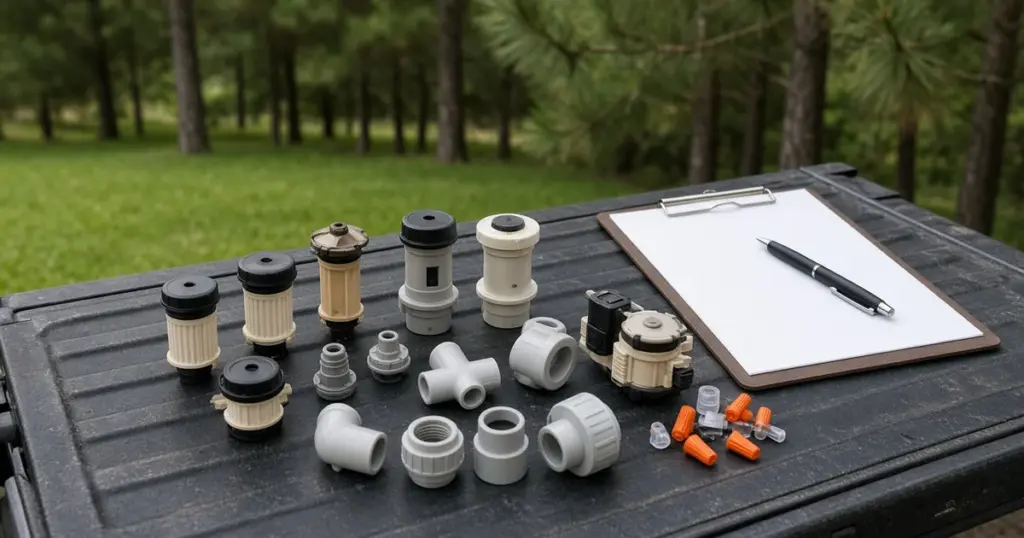
“How much does it cost to fix a sprinkler?” is one of the first questions people ask, and the honest answer is that it depends on what is actually wrong. A clogged nozzle and a cracked main line under a driveway can both start with the same symptom: a dry patch of lawn. One is a quick fix, the other is a real project.
We do not publish set prices, because a number without a diagnosis is just a guess, and guesses tend to be wrong in one direction or the other. What we can do is explain the factors that shape a repair quote, so you know what to expect and can ask good questions. This applies to repairs on residential systems around Huntsville, TX and Walker County, though the principles are universal.
Factor 1: How Long It Takes to Find the Problem
Diagnosis is often the biggest variable. Some problems are visible the moment a zone runs: a broken head geysering, a nozzle clogged with sand. Others take investigation:
- A zone that will not turn on could be a solenoid, a cut wire, a controller issue, or a failed valve.
- A high water bill could be a main-line leak that never surfaces in sandy soil.
- Weak pressure could be a leak, a partly closed valve, or an overloaded zone.
Hidden problems take longer to locate, and sometimes specialized tools such as wire tracers or valve locators. Our article on leak detection and repair technology describes some of those tools. The sprinkler troubleshooting guide can help you gather useful information beforehand, which can shorten diagnosis.
Factor 2: What Part Has Failed
Different components carry different repair scope:
- Heads and nozzles are usually the simplest repairs.
- Swing joints and fittings require digging around the head.
- Lateral line breaks require exposing and splicing pipe.
- Main line breaks affect the constantly pressurized part of the system and can be more urgent and involved.
- Valves may need a new solenoid, a diaphragm rebuild, or full replacement.
- Wiring faults range from a single bad splice to a buried break that has to be traced.
- Backflow assemblies may need a repair kit or replacement, plus testing by a licensed tester.
- Controllers may need reprogramming, a new component, or replacement.
Factor 3: Access
Where the problem sits makes a big difference:
- Is the pipe under open lawn, or under a sidewalk, driveway, patio, or deck?
- Is the valve box buried or lost under landscaping?
- Are there tree roots wrapped around the line?
- Is the area tight against the foundation or a fence?
Repairs under hardscape or among large roots take more labor and care. Our article on how pine and hardwood roots damage irrigation lines explains why root-related repairs often take longer.
Factor 4: Pipe Type and Depth
Rigid PVC and flexible poly pipe are repaired with different fittings and methods. Depth matters too, because deeper lines take more digging. Older systems sometimes have mixed materials from past repairs, which can complicate things.
Factor 5: Parts and Brand Compatibility
Most common irrigation brands have widely available replacement parts. Discontinued valves, uncommon controllers, or very old heads may require adapting to a newer model. Matching heads on a zone, meaning the same type and similar precipitation rate, is also important for even watering, which sometimes means replacing more than one head.
Factor 6: What Else Turns Up
Opening up one problem sometimes reveals another: a second crack near the first, a corroded wire splice next to the valve, or roots that will soon crush a nearby section. A good technician will tell you what they found and let you decide what to address now.
Factor 7: Urgency and Timing
A running main-line leak or a stuck-open valve that you cannot shut off needs prompt attention. Scheduled repairs during normal hours are generally simpler to plan than urgent calls. If water is running and you cannot stop it, see our emergency service page.
How to Get an Accurate Quote
You can help make a quote more accurate:
- Describe the symptom precisely. Which zone, what you see, and when it started.
- Note anything recent. New landscaping, a fence, a freeze, or a storm.
- Know where your controller, valves, and backflow assembly are, if you can.
- Check your water meter with everything off. A moving leak indicator is useful information.
- Ask what is included. Diagnosis, parts, labor, testing, and restoration.
Repair vs. Upgrade
Sometimes a repair is a good moment to improve the system: adding check valves on a slope, swapping a misting head for a pressure-regulated one, or converting a bed to drip. Those are optional, and a good technician should explain the tradeoffs rather than push them. The efficient irrigation guide covers which upgrades tend to matter most.
Why Licensing Matters for Repairs
In Texas, irrigation repair work done for someone else must be performed by or under the supervision of a TCEQ-licensed irrigator, and backflow assemblies must be tested and repaired by a licensed tester. Licensed work protects you and your water supply, and it means the repair meets state standards.
When to Call a Pro
Call when the problem goes beyond a nozzle cleaning or simple head swap, when you cannot find the cause, when water is running continuously, or when the repair involves the main line, valves, wiring, or backflow assembly. A professional diagnosis is the only way to get a real number. Our sprinkler repair page describes the repairs we handle, and our FAQ page answers common questions about service.
Frequently Asked Questions
Why won’t you give me a price over the phone?
Because the same symptom can have very different causes. We can talk through what you are seeing and explain likely possibilities, but an accurate quote requires a diagnosis.
Is it cheaper to fix problems early?
Generally, yes. Small leaks and worn parts tend to get worse, and a leak left running can damage turf, soil, and hardscape. Early repairs are usually simpler.
Can I reduce repair costs by doing some work myself?
Simple tasks such as cleaning nozzles, adjusting heads, and raising sunken heads are reasonable for homeowners. Leave valves, main lines, wiring faults, and backflow work to licensed professionals.
Call for a Quote
For an honest diagnosis and a clear quote, call 346-586-6060 or request service online. We serve homeowners throughout Huntsville and Walker County.