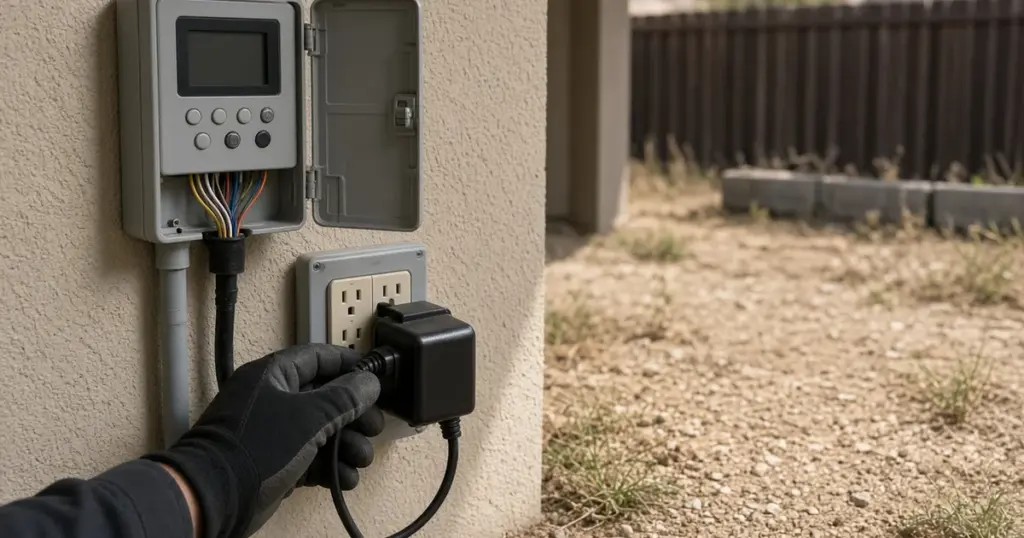
When a single zone fails, the problem is usually at that zone: a valve, a solenoid, or a wire. When nothing runs at all, the cause is almost always upstream of the zones, somewhere every zone depends on. That narrows the search a lot. Instead of digging through valve boxes one at a time, you work from the top of the system down: power, controller, sensors, the common wire, any master valve or pump, and finally the water supply.
This guide lays out that top-down diagnosis in the order that tends to find the problem fastest. It is written for homeowners in Huntsville, TX and Walker County, but the logic applies to nearly any residential system.
Before You Start: Is It Really Everything?
Confirm that no zone runs, both on schedule and when started manually. Sometimes it seems as if nothing works when only the zones you can see from the house are failing, or when the schedule was simply changed. Try a manual start of two or three different zones and walk out to check each.
If some zones work and others do not, this is a different problem. Our existing article on why one sprinkler zone won’t turn on is the better starting point.
Level 1: Power
Is the controller on?
A blank display is the clearest sign of a power problem.
- Check the outlet. Plug in a lamp or phone charger to confirm it has power.
- Check GFCI outlets. Garage and outdoor outlets are often on a GFCI circuit that trips, sometimes from a different outlet on the same circuit.
- Check the breaker.
- Check the transformer. Plug-in controllers use a transformer; if it has failed, the display may be blank or the valves may not get enough voltage.
Is there a fuse or circuit breaker in the controller?
Many controllers have an internal fuse or a resettable circuit breaker that trips when a short occurs on a valve circuit. If it trips again immediately after resetting, there is likely a short in the field wiring.
Level 2: Controller Settings
A controller with power can still be set so that nothing runs.
- Mode or dial position. Make sure it is set to automatic run, not off.
- Rain delay. A rain delay may have been set manually or by a smart controller responding to forecast rain.
- Seasonal adjust. A percentage set to zero or near zero effectively stops watering.
- Date, time, and AM/PM. A wrong clock can make the schedule run at unexpected times.
- Watering days. Programs with no days selected, or an odd/even setting that does not match, will not run.
- Program start times. A missing start time means the program never begins.
For smart controllers, check the app for a weather skip or an offline status. If you recently replaced the controller, recheck the wiring; our article on replacing an old sprinkler controller covers common mistakes.
Level 3: Sensors
Rain, freeze, and soil moisture sensors can stop all watering when they detect rain or cold. That is their job, but a stuck or failed sensor can stop watering permanently.
- Check for a sensor alert on the display.
- Use the sensor bypass switch briefly to test. If zones run with the sensor bypassed, the sensor is holding the system off.
- Inspect the sensor. Rain sensors with swollen discs may take a long time to dry out. Wires can be damaged.
Our article on rain and freeze sensors explains how they work. Do not leave the sensor permanently bypassed; Texas rules require rain or moisture shut-off on automatic systems, and a working sensor saves water.
Level 4: The Common Wire
Every valve shares the common wire. If the common is cut or disconnected, no zone can complete its circuit.
- Check the common terminal at the controller to make sure the wire is attached.
- Think about recent digging. A cut common is a classic result of fence, landscaping, or utility work.
- Use a multimeter to measure between the common and each zone terminal. Open readings on every zone point toward the common.
The guide to sprinkler wire repair explains how to find and splice a broken wire.
Level 5: Master Valve or Pump
Some systems have a master valve that opens only when a zone runs, or a pump start relay for well or lake water systems.
- Master valve: If it fails closed, no zone gets water even though the zone valves open electrically. You may hear a click at the zone valve but see no water.
- Pump start relay: If the relay fails, the pump never starts and no zone gets water. Check the relay, its power, and the pump itself.
Level 6: Water Supply
If the electrical side checks out, look at the water.
- Is the irrigation shutoff open? It may have been closed for a repair or freeze and never reopened.
- Are the backflow assembly’s valves open? The assembly has its own shutoff handles.
- Is there water at the house? A main supply issue affects everything.
- For well systems, is the pump running and the pressure tank holding pressure?
Quick Reference Table
| What you see | Likely level |
|---|---|
| Blank display | Power |
| Display on, no zones start | Settings or sensor |
| Zones start on display, valves silent | Common wire or fuse |
| Valves click, no water | Supply, master valve, or pump |
When to Call a Pro
If you have worked through these levels and nothing runs, or if the controller fuse keeps tripping, a technician can trace the problem with proper test equipment. Call right away if the system has no water because of a leak you shut off, or if a main line is broken. The sprinkler troubleshooting guide covers other symptoms. We help homeowners in Huntsville and Walker County restore systems that have stopped working. See our emergency service page for urgent problems and our sprinkler repair page for diagnostics.
Frequently Asked Questions
Why does my controller display show the zone running but no water comes out?
The electrical signal may not be reaching the valve because of a broken common wire, or the water supply, master valve, or pump may be off.
Can a rain sensor stop my whole sprinkler system?
Yes. When a rain or freeze sensor is active, it stops all scheduled watering. A failed sensor can keep the system off until it is repaired or replaced.
What does it mean if my controller fuse keeps blowing?
It usually indicates a short in a valve solenoid or field wire. Disconnecting zones one at a time can identify which circuit is shorted.
Get Your System Running Again
If your sprinklers will not run at all, call 346-586-6060 or request service.