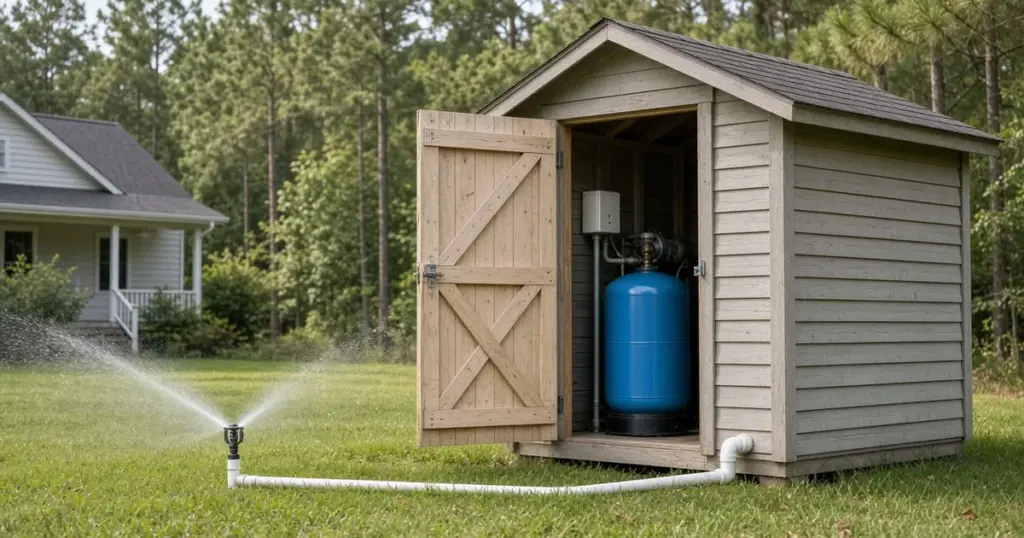
On properties served by a private well, the irrigation system is only as good as the pump, pressure tank, and controls that feed it. A city water connection delivers relatively steady pressure and flow. A well system delivers whatever the pump can produce, moderated by the pressure tank and the pressure switch. When the sprinkler zones are sized and scheduled to fit that supply, a well-fed system can work very well. When they are not, the result is weak coverage, a pump that cycles on and off constantly, and shorter equipment life.
This guide explains how the pieces work together, the warning signs of a mismatch, and what can be done about it. It is written for rural and acreage properties around Huntsville, TX and Walker County. Note that inside Huntsville city limits, the city’s Unified Development Code prohibits irrigation wells, so this applies mainly to properties outside the city.
How a Well System Supplies Irrigation
The pump
A submersible or jet pump draws water from the well and pushes it into the plumbing. Pumps are rated for a range of flow and pressure.
The pressure tank
The tank stores a small volume of pressurized water. It smooths out pressure and lets the pump rest between starts.
The pressure switch
The switch starts the pump when pressure drops to a set point and stops it when pressure reaches a higher set point.
Some systems use a pump start relay
On systems where the irrigation controller turns the pump on directly, a pump start relay connects the controller to the pump circuit. The controller signals the relay whenever a zone runs.
Our existing article on well water irrigation systems introduces these components and the common issues.
The Short Cycling Problem
Short cycling means the pump turns on and off rapidly. It happens when a sprinkler zone uses water at a rate that is close to, but not matched with, what the pump delivers. The pump runs, builds pressure, shuts off, pressure drops quickly as the zone draws water, and the pump starts again.
Signs of short cycling:
- The pump clicks on and off every few seconds or minutes while a zone runs.
- Spray pulses stronger and weaker.
- Pressure gauge swings widely.
Short cycling wears out pumps, switches, and relays. It is one of the most important things to fix on a well-fed irrigation system.
Matching Zones to the Well
The fix is often to adjust the irrigation to the well rather than the other way around:
- Measure what the well delivers. A technician can measure flow and pressure during a run.
- Calculate each zone’s demand from the heads and nozzles.
- Resize zones that demand too much, by splitting them or reducing nozzle sizes.
- Consider a constant pressure system or pump controls designed for irrigation where appropriate. These decisions often involve a well and pump specialist.
- Schedule zones so the well can recover between them if needed.
Filtration
Well water may carry sand, sediment, and dissolved minerals. A properly sized filter on the irrigation supply protects valves, nozzles, and drip emitters. Clean it regularly. Our guide to clogged sprinkler nozzles and filter screens explains what happens when debris gets through.
Iron in well water can cause rust-colored stains on walls, walks, and fences. See iron staining from well water sprinklers for ways to reduce it.
Backflow Protection
Wells need protection too. If the irrigation system connects to a public water supply anywhere, an approved backflow prevention assembly is required, with testing by a licensed tester under TCEQ rules. On a well-only system, protecting the well from contamination is still important, especially if fertilizer or other chemicals are injected. Our article on private well sprinkler rules in Walker County covers this topic further.
Leak Detection on Well Systems
With no utility meter, leaks show up as a pump that runs when no water is in use, or more often than normal. A flow sensor and master valve can help catch irrigation leaks; see flow sensors and master valves.
Seasonal Care
- Spring: Check the pressure tank, pressure switch, filter, and every zone.
- Summer: Watch for short cycling and pump strain during long runs.
- Fall: Clean the filter and check for sediment buildup.
- Winter: Protect the wellhead, exposed pipe, pressure tank, and backflow assembly from freezing.
Signs of Trouble
| Symptom | Possible cause |
|---|---|
| Pump cycles rapidly during zones | Zone demand mismatched with pump and tank |
| Weak spray on all zones | Pump capacity, clogged filter, pressure switch setting |
| Pump runs constantly | Leak, worn pump, or demand exceeding capacity |
| No water to zones | Pump relay, pressure switch, power, or pump failure |
| Sand in heads | Well sediment, failed filter |
Who Does What
Irrigation professionals work on the sprinkler side: zones, heads, valves, controllers, and filters. Well pump, pressure tank, and well construction work is often handled by a licensed well or pump specialist. Many problems require both. A clear diagnosis tells you which professional you need.
When to Call a Pro
Call a professional if the pump short cycles, if zones have weak or pulsing spray, if the system will not run, or if heads clog repeatedly. A technician can measure flow and pressure, resize zones, and recommend whether a well specialist is needed. We work on well-supplied irrigation across Walker County, including rural areas around Huntsville and towns like Dodge. The backflow prevention and testing guide covers protection requirements. Visit our irrigation installation page and sprinkler repair page.
Frequently Asked Questions
Why does my well pump turn on and off when the sprinklers run?
The zone may use water at a rate that does not match what the pump and tank deliver, causing short cycling. Adjusting zone size often helps.
Can I run sprinklers and household water at the same time from a well?
It depends on the well’s capacity. Running both can reduce pressure. Scheduling irrigation when household use is low helps.
Do I need a filter on a well irrigation system?
A filter is strongly recommended to protect valves, nozzles, and emitters from sediment.
Get Your Well System Working With Your Sprinklers
Call 346-586-6060 or request service for help with well-supplied irrigation.