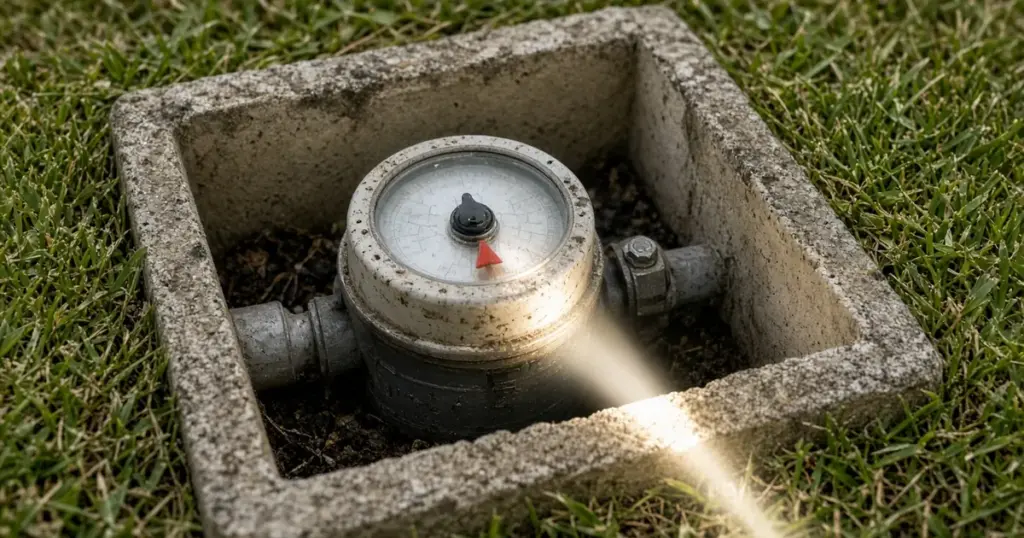
Your water meter is one of the best leak detectors you have. It measures every gallon that enters the property, so if water is moving when nothing should be using it, the meter will show it. A simple meter test can tell you whether you have a leak, whether it is on the irrigation side or the house side, and in many cases whether it is on the irrigation main line or a specific zone.
This guide explains how to find and read the meter, and how to run a step-by-step test for irrigation leaks at a home in Huntsville, TX or anywhere in Walker County.
Finding Your Water Meter
Residential water meters are usually in a box near the street or property line, often with a lid marked “water.” Open the lid carefully; meter boxes can hold insects, spiders, or snakes. Clear away any dirt or water so you can see the meter face.
If your water comes from a private well, there is no utility meter. Pump behavior and pressure gauges serve a similar purpose; see the section on wells below.
Reading the Meter
Meter designs vary, but most have:
- A main register showing total water use.
- A sweep hand or digital display showing smaller increments.
- A leak indicator, often a small triangle, star, or wheel that spins with even very small flows.
The leak indicator is the most important part for this test. If it moves when no water is in use, water is flowing somewhere.
The Basic Leak Test
- Turn off all water use inside and outside the house: faucets, toilets, dishwasher, washing machine, ice maker, hoses, and pool fill.
- Make sure no irrigation zone is running. Set the controller to off.
- Watch the leak indicator for a few minutes.
- If it does not move, you likely have no significant leak at the moment.
- If it moves, you have a leak somewhere downstream of the meter.
For a slower leak, record the main register reading, wait an hour or more with no water use, and read it again.
Separating Irrigation From the House
If the meter shows a leak:
- Close the irrigation supply valve, usually located near the backflow assembly or where the irrigation line leaves the house supply.
- Watch the meter again.
- If the indicator stops, the leak is on the irrigation side, likely on the main line or the backflow assembly.
- If it keeps moving, the leak is likely in the house plumbing or the service line, and a plumber may be needed.
Narrowing Down an Irrigation Leak
Main line or backflow assembly
If the meter stops when the irrigation supply is closed, the leak is on the constantly pressurized part of the system. Inspect the backflow assembly for drips and look for wet areas along the main line route and around valve boxes. A flooded box can point to a leak near a valve; see what a flooded valve box is telling you.
Zone lateral lines
Lateral lines are only pressurized while their zone runs, so they do not show up on the basic test. To check them:
- Record the meter reading.
- Run one zone for a set time.
- Record the reading again.
- Compare zones of similar size and head type. A zone using noticeably more than expected may have a leak or a broken head.
Walk the zone while it runs and look for bubbling, geysers, or soggy spots.
Our article on main line vs. lateral line leaks explains the difference in more detail.
Signs to Look for Outdoors
The meter tells you that water is moving. These clues help you find where:
- Soft, soggy spots that do not dry out.
- Unusually green patches during dry weather.
- Sunken soil or small sinkholes.
- Water seeping from a valve box or near the backflow assembly.
Our existing post on signs of an underground sprinkler leak covers more clues, and our existing article on stopping sprinkler leaks and mold explains moisture problems around the home.
If You Are on a Well
With no utility meter, watch the pump and pressure tank. If the pump turns on periodically when no water is in use, there may be a leak. Close the irrigation supply and see whether the cycling stops.
Keeping a Simple Log
Write down the main register reading and the date each time you test, along with any notes like “zone 3 ran 15 minutes.” Over a season, the log shows how much water each zone normally uses and makes changes easy to spot. It also gives a technician useful information if a leak does turn up.
How Often to Test
A meter test takes only a few minutes. Run one whenever your water bill jumps, after freezes, after digging work near irrigation lines, and at the start of each watering season.
Common Mistakes
- Forgetting an appliance like an ice maker or water softener that uses water intermittently.
- Not waiting long enough for very slow leaks.
- Testing while a zone is running.
- Assuming a moving indicator is always irrigation without closing the irrigation supply.
When to Call a Pro
Call a professional if the meter test points to an irrigation leak you cannot find, if the leak is near a foundation or under hardscape, if the backflow assembly is leaking, or if your bill keeps rising. The sprinkler leak repair guide explains how technicians locate and repair leaks. We find and fix irrigation leaks for homes across Huntsville and Walker County. See our sprinkler repair page and our emergency service page for active leaks.
Frequently Asked Questions
What does the little triangle on my water meter mean?
On many meters, it is a leak indicator. It spins with even small flows, so movement with all water off suggests a leak.
Can a sprinkler leak raise my water bill?
Yes. A main line leak runs continuously, and even lateral leaks waste water every time a zone runs.
Is it safe to open my water meter box?
Generally, yes, but open it carefully and watch for insects or animals inside. Do not tamper with the meter itself.
Leak Detection and Repair
If your meter shows a leak, call 346-586-6060 or request service.