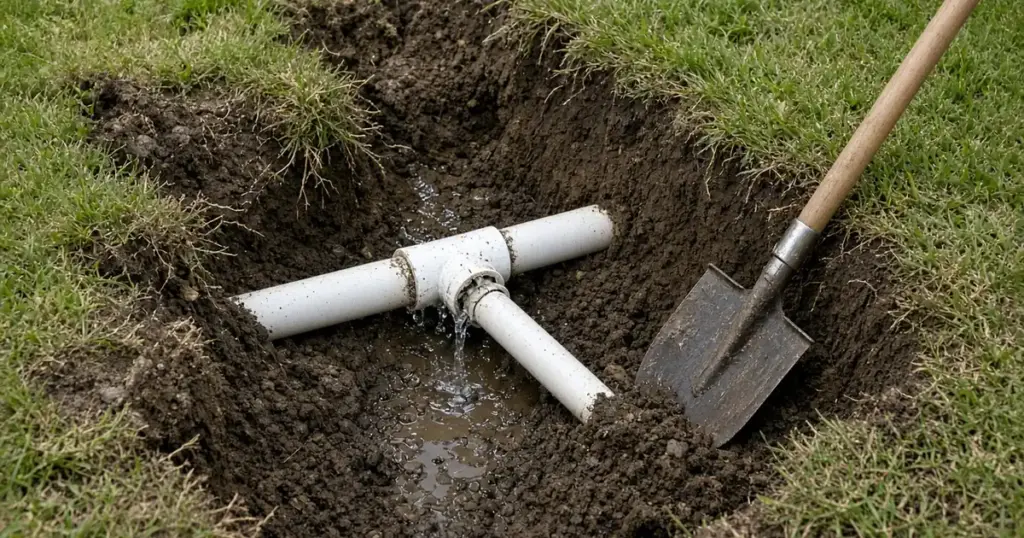
Not all sprinkler leaks are equal. A leak on a lateral line, the pipe that runs from a zone valve to its heads, only loses water while that zone runs. A leak on the main line, the pipe that carries water from the supply to the valves, can lose water around the clock, because the main line stays pressurized whenever the system’s supply is on.
That difference changes how urgently you should act, how you track the leak down, and what a repair involves. This article explains the two types of pipe, how to tell which one is leaking, and what to do next, with notes for the sandy-over-clay soils common around Huntsville, TX and Walker County.
How the Two Lines Work
Main line
The main line starts after the backflow assembly and runs to the zone valves. On most residential systems, it is under constant pressure, the same as the house plumbing. If the system has a master valve, the main line between the master valve and the zone valves is only pressurized during watering.
Lateral lines
Each zone valve feeds a lateral line that runs to the heads in that zone. Laterals are pressurized only when their valve is open. When the valve closes, the pressure drops, though some water may drain out of low heads. That drainage is different from a leak; our post on low-head drainage explains it.
Telling Them Apart
| Clue | Main line | Lateral line |
|---|---|---|
| Water appears when system is off | Yes | No (except low-head drainage) |
| Meter moves with all zones off | Yes, if irrigation supply open | No |
| Wet spot only when one zone runs | No | Yes |
| Affects pressure on all zones | Often | Only one zone |
The meter test
The simplest way to separate the two:
- Turn off all water use in and around the house.
- Make sure no zones are running.
- Watch the water meter’s leak indicator.
- If it moves, close the irrigation shutoff. If it stops, the leak is likely on the irrigation main line or backflow assembly. If it keeps moving, the leak may be on the house side.
Our article on using the water meter to test for sprinkler leaks walks through this in more detail.
The zone test
Run each zone and look for soggy areas, bubbling, or weak heads. A leak that only shows during one zone’s cycle is on that zone’s lateral.
Why Main Line Leaks Are More Urgent
- Continuous water loss. The leak runs day and night.
- Soil damage. Constant water can soften soil, cause settling, and create sinkholes in sandy soil.
- Foundation and hardscape concerns. Leaks near slabs, driveways, or walks can undermine them.
- Higher bills. Water loss adds up quickly.
If you find a main line leak, close the irrigation supply valve until it is repaired. That stops the loss while keeping house water on.
Finding the Leak Location
In sandy soil over clay, water can travel along the clay layer and surface away from the break. Look for:
- The wettest spot, which is often near but not exactly at the break.
- Sunken or soft soil.
- Unusually green or lush patches during dry weather.
- Water in valve boxes, which can point toward a leak near a valve.
Our existing post on signs of an underground sprinkler leak lists more clues.
Repairing Each Type
Lateral line repairs
Laterals are usually smaller pipe and shallower. Repairs involve exposing the pipe, cutting out the damaged section, installing a repair fitting, flushing, and testing. Our guide to repairing a broken sprinkler pipe walks through each step.
Main line repairs
Main lines are often larger and deeper, may run under hardscape, and require the supply to be shut off for the repair. Because they are always pressurized, an imperfect repair will show up quickly. Professional repair is often worth it.
Do Not Confuse These With Valve Problems
A zone that keeps running or weeps water at its heads after shutting off may have a valve problem rather than a pipe leak. Debris or a worn diaphragm can keep the valve partially open. Our existing post on a sprinkler zone that won’t shut off covers that issue.
What About Systems With a Master Valve?
A master valve changes the picture. It sits near the start of the main line and opens only when a zone runs, so the main line downstream of it is pressurized only during watering. On these systems, a main line leak downstream of the master valve behaves more like a lateral leak: it loses water only during cycles, but during every zone’s cycle, not just one. If you see a wet spot that appears whenever any zone runs, suspect the main line between the master valve and the zone valves.
The pipe between the backflow assembly and the master valve is still under constant pressure, so a leak there behaves like a conventional main line leak.
Temporary Measures While You Wait
- Close the irrigation supply for main line leaks.
- Turn the controller off or set a rain delay so zones do not run on a leaking lateral.
- Mark the wet area with flags so it is easy to find later.
- Keep people and vehicles off soft, saturated soil.
- Water by hand if plants need it before the repair.
Preventing Line Leaks
- Mark pipe routes before digging, aerating, or installing fences.
- Manage roots near pipes.
- Keep pressure in range. Excessive pressure stresses pipe and fittings.
- Protect exposed pipe from freezes.
- Repair properly with the right fittings the first time.
When to Call a Pro
Call a professional promptly for any suspected main line leak, any leak near a foundation or under hardscape, or any leak you cannot locate. Close the irrigation supply in the meantime. The sprinkler leak repair guide explains the broader repair process. Homeowners in Huntsville and Walker County can reach us for urgent leaks through our emergency service page or see our sprinkler repair page for routine repairs.
Frequently Asked Questions
How do I know if my sprinkler main line is leaking?
Signs include a moving meter with all zones off and the house water unused, wet spots that persist when the system is off, and low pressure across all zones.
Can I keep using my sprinklers with a main line leak?
It is best to close the irrigation supply and repair the leak first. Running the system adds pressure and water loss.
Are lateral line leaks less serious?
They lose water only while the zone runs, so they are usually less urgent, but they still waste water and can cause soggy areas and erosion.
Leak Help Is a Call Away
If you suspect a main line or lateral leak, call 346-586-6060 or request service.