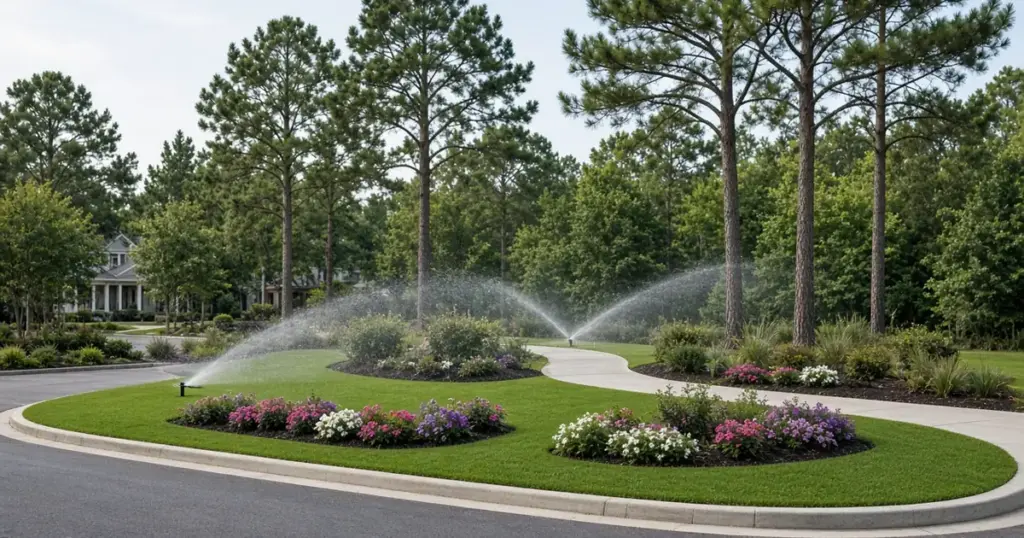
Homeowners associations manage some of the most visible landscapes in a neighborhood: the entrance monuments, medians, parks, detention pond banks, and the strips along perimeter fences. Residents notice when those areas look good, and they notice even more when water runs down the street from a broken head or sprays onto a passing car. Common area irrigation is often spread across several controllers and water meters, managed by volunteer boards and changing landscape contractors. That makes a clear plan especially valuable.
This guide outlines how HOAs in Huntsville, TX and across Walker County can keep common area irrigation efficient, compliant, and predictable.
Typical HOA Irrigation Areas
- Entrances and monuments, often with seasonal color beds.
- Medians and islands surrounded by pavement.
- Parks and amenity areas with turf and trees.
- Perimeter strips along fences and roads.
- Detention or retention areas, sometimes irrigated on the banks.
Each has different water needs and challenges, so they should be zoned and scheduled separately.
Common Problems
Overspray onto streets and sidewalks
Medians and narrow strips are hard to water with spray. Texas standards for new installations prohibit above-ground spray in areas less than 48 inches wide bordered by pavement on two or more sides and require heads to be at least 4 inches from hardscape and directed away from it. Older systems may not meet these standards. Our guide to stopping overspray and runoff covers fixes.
Unnoticed breaks
Common areas often have no one watching during watering. A broken head can run every cycle for weeks.
Vehicle and equipment damage
Heads near curbs and in medians get hit by vehicles, mowers, and trucks.
Multiple controllers
Different sections may have their own controllers and meters, with programs set by different contractors over the years.
Backflow theft and damage
Assemblies in exposed common areas can be damaged or stolen. See backflow preventer covers and enclosures.
A Management Plan
1. Inventory the system
Map every controller, meter, backflow assembly, valve, and zone. Record controller models and programs. This document becomes the HOA’s reference for contractors.
2. Set a maintenance schedule
Monthly checks in the growing season, seasonal schedule changes, and annual backflow testing and audits. Our guide to commercial irrigation maintenance outlines a similar calendar.
3. Centralize control
Smart controllers with remote access let a manager or contractor see and adjust all sites from one app. Our existing article on whether smart sprinkler controllers are worth it covers the trade-offs.
4. Add leak protection
Flow sensors and master valves can detect breaks and shut down a zone automatically. See flow sensors and master valves.
5. Convert problem areas
Medians, narrow strips, and monument beds are often better served by drip or low-water landscaping.
6. Keep records
Backflow test reports, repair invoices, and inspection reports should be kept in one place that survives board turnover.
Watering Restrictions
If an HOA’s common areas are served by the City of Huntsville, its drought plan sets watering days by property type when a stage is declared, along with a ban on sprinkler irrigation from 7 a.m. to 7 p.m. Check which category the common area accounts fall under and the city’s current notices. Properties served by other providers should check those providers’ plans.
Backflow Responsibilities
Common area irrigation connected to public water requires approved backflow protection, tested by a licensed tester after installation, repair, replacement, or relocation under TCEQ rules, with results provided to the water provider. Many providers require annual tests. The HOA, as the customer, is typically responsible for arranging testing and keeping records.
Budgeting
Boards benefit from predictable costs:
- Routine maintenance and inspections.
- Annual backflow testing.
- A reserve for repairs such as heads, valves, and pipe.
- Planned upgrades like controller replacement and drip conversions, phased over several years.
We do not publish set prices; call for a quote based on the community’s system.
Communicating With Residents
Residents often report problems first. A simple way to report broken heads or water running in common areas, such as an email address or online form, gets issues fixed faster. Sharing the watering schedule helps residents know when water in a median is expected and when it is a problem.
Working Through Board Turnover
HOA boards change, and institutional knowledge can disappear with them. A short irrigation handbook kept with the association’s records helps new board members get up to speed. Include the system map, controller locations and access codes, the maintenance schedule, contractor contacts, the backflow testing history, and a list of known problem areas. Reviewing the handbook once a year, usually before the growing season, keeps it current.
Choosing a Contractor
When an HOA selects an irrigation contractor, it helps to ask clear questions. In Texas, irrigation work must be performed by or under the supervision of a licensed irrigator, and backflow testing must be done by a licensed tester. Ask how the contractor reports findings, whether they provide written inspection reports, how they handle emergency breaks, and whether they will maintain the system map and controller records. A contractor who documents work makes the next board’s job easier.
Seasonal Priorities for Common Areas
Spring is the time for startup inspections and repairs before growth begins. Summer brings peak demand, so monthly checks and fast response to breaks matter most. Fall is for reducing schedules, aerating, and planning upgrades for the next budget year. Winter calls for freeze protection on exposed assemblies and a lighter schedule.
When to Call a Pro
Call a professional to inventory and map the system, to set up a maintenance and backflow testing program, to fix overspray and recurring breaks, or to plan phased upgrades. The East Texas service area guide covers the communities we serve. We work with HOAs and property managers across Huntsville and Walker County. See our services page and our irrigation installation page.
Frequently Asked Questions
Who is responsible for HOA common area irrigation?
Typically the HOA, often through a property manager or landscape contractor. Governing documents define responsibilities.
How can an HOA reduce irrigation water use?
Fix leaks and overspray, use smart controllers, convert narrow strips and medians to drip, and adjust schedules seasonally.
Do HOA backflow assemblies need annual testing?
Requirements depend on the water provider and assembly type. Testing is always required after installation or repair.
HOA Irrigation Service
For help managing common area irrigation, call 346-586-6060 or request a proposal.