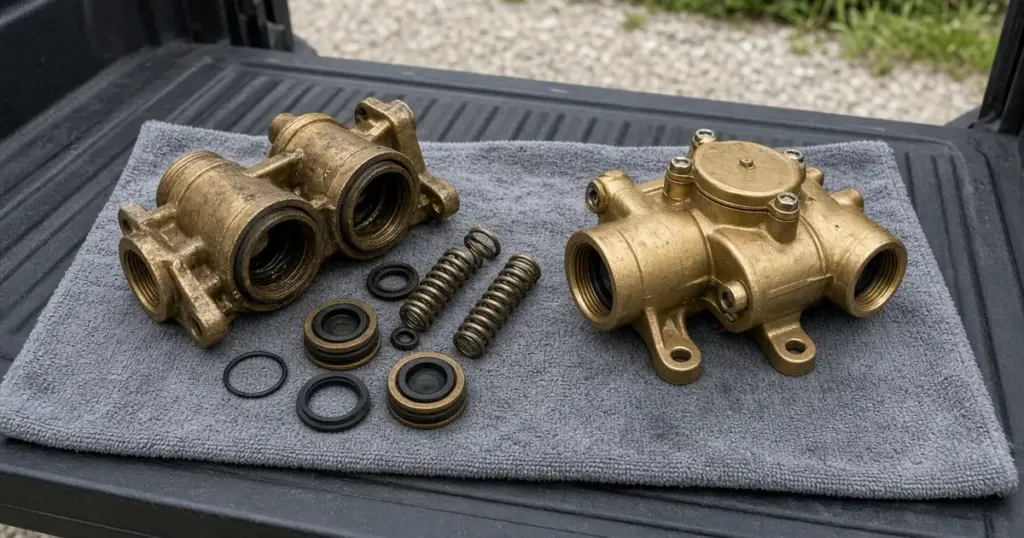
When a backflow assembly fails a test, drips constantly, or shows damage after a freeze, the next question is whether to repair it or replace it. A rebuild, which means cleaning the assembly and installing new rubber parts and springs, can restore many assemblies to full function. In other cases, the body is cracked, parts are unavailable, or the assembly is the wrong type for the property, and replacement is the better choice.
This article explains how that decision gets made for irrigation backflow assemblies on homes and businesses in Huntsville, TX and Walker County, what each option involves, and what testing is required afterward.
What Can Go Wrong Inside an Assembly
Backflow assemblies contain check valves, springs, seals, and, depending on type, a relief valve or air inlet. Common internal problems include:
- Debris on a check seat, such as sand or pipe shavings, that prevents a tight seal.
- Worn or hardened rubber on check discs, diaphragms, and O-rings.
- Weak or broken springs.
- A sticking relief valve or air inlet.
External and structural problems include:
- Cracked bodies or bonnets from freezing.
- Damaged threads or test cocks.
- Impact damage from mowers or vehicles.
- Corrosion on older assemblies.
Our earlier post on backflow preventer problems in Huntsville describes the visible warning signs.
When a Rebuild Makes Sense
A rebuild is often the right choice when:
- The body and bonnet are intact, with no cracks or damaged threads.
- Repair kits are available for that make and model.
- The problem is internal, such as debris, worn rubber, or a weak spring.
- The assembly is the correct type for the property and installed correctly.
A rebuild typically involves isolating the assembly, disassembling it, cleaning internal parts, replacing rubber components and springs with the manufacturer’s kit, reassembling, and then testing.
Sometimes simply cleaning debris from a check seat solves a failed test. A licensed tester will often try that first.
When Replacement Makes More Sense
Replacement is usually the better option when:
- The body or bonnet is cracked, most often from a freeze.
- Parts are no longer available for an older or discontinued model.
- The assembly is the wrong type. For example, an assembly that does not meet the requirements for a property with a septic system or chemical injection, where TCEQ guidance calls for a reduced pressure principle assembly.
- The installation does not meet requirements, such as a pressure vacuum breaker installed below the highest head, which must be at least 12 inches above the highest downstream opening per TCEQ guidance.
- Repeated repairs suggest the assembly is near the end of its useful life.
- Corrosion has affected threads or test cocks.
For a comparison of assembly types and installation rules, see PVB vs. RPZ vs. double check.
Testing After Either Option
Under TCEQ rules, backflow prevention assemblies must be tested by a licensed tester after installation, repair, replacement, or relocation. That means a rebuilt assembly and a new assembly both need a passing test before the irrigation system goes back into normal service, and results go to the water provider as required. Our article on what happens during an irrigation backflow test explains the procedure.
Inside Huntsville city limits, replacing an irrigation RPZ is the kind of work that has appeared on the city’s plumbing permit records, so ask whether a permit applies to your project.
What to Expect During the Visit
Whether the assembly ends up rebuilt or replaced, the visit follows a similar pattern. The technician isolates the assembly by closing its shutoff valves, so household water is usually unaffected while irrigation is off. After a visual inspection, they may run a diagnostic test to see which component is failing. If a rebuild is the plan, the assembly is opened, cleaned, and fitted with new parts. If replacement is needed, the old unit is removed, the new one is installed according to the manufacturer’s instructions with proper clearance for testing, and the connections are checked for leaks.
In both cases, the job is not finished until the assembly passes a test and the paperwork is filed with the water provider. Ask for a copy of the test report for your records.
Factors That Affect the Decision
Age and history
An assembly with a long record of passing tests and a single recent failure is a good rebuild candidate. One that has failed repeatedly or needed several repairs may be better replaced.
Freeze exposure
If an assembly sits in an exposed spot and has cracked once, consider protection along with replacement: an insulated cover, an enclosure, and a plan to drain it before hard freezes. Our existing article on protecting irrigation and backflow from freezes covers prevention.
Location
Sometimes replacement is an opportunity to relocate an assembly that is in a bad spot, such as directly in a mower path or where it is hard to access for testing. Relocation also requires testing afterward.
Parts availability
Common brands and models have readily available repair kits. Uncommon or older units may not.
What Owners Can Do
- Keep test reports. They show patterns over time.
- Protect the assembly from freezes and impact.
- Report leaks promptly. A dripping assembly is telling you something.
- Do not attempt internal repairs yourself. Repairs and testing of backflow assemblies must be done by a licensed tester.
When to Call a Pro
Call a professional if your assembly failed a test, is leaking or discharging water, was damaged by a freeze or vehicle, or if you are not sure it is the right type for your property. A licensed tester can diagnose the problem, recommend rebuild or replacement, perform the work, and complete the required test. See our sprinkler repair page for repairs and our services page for testing and replacement. The backflow prevention and testing guide covers the bigger picture.
Frequently Asked Questions
Is it cheaper to rebuild or replace a backflow preventer?
It depends on the problem, the assembly, and parts availability. A simple cleaning or repair kit is often less involved than a replacement, but a cracked body leaves no choice. Call for a quote based on your assembly.
Can a freeze-cracked backflow assembly be repaired?
If the crack is in a replaceable part such as a bonnet, a repair may be possible. A cracked body usually means replacement.
Do I need a new test after a repair?
Yes. TCEQ rules require a test by a licensed tester after repair, replacement, or relocation.
Get Your Backflow Assembly Back in Service
If your assembly failed a test or was damaged, call 346-586-6060 or request service online. We help property owners across Huntsville and Walker County repair, replace, and test backflow assemblies.