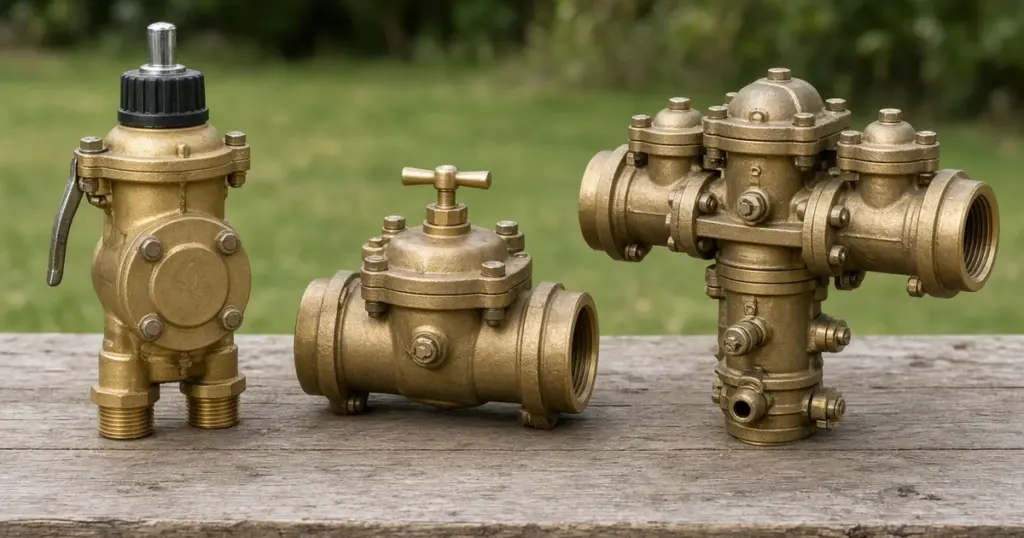
If you look at the brass device where your irrigation system connects to the water supply, you are probably looking at one of three types of backflow prevention assembly. They all do the same basic job, keeping irrigation water from flowing back into drinking water, but they do it in different ways, offer different levels of protection, and come with different installation rules.
This comparison explains each type, when it is used, and what it means for testing, freeze protection, and repairs on properties in Huntsville, TX and Walker County.
Quick Comparison
| Feature | Pressure vacuum breaker (PVB) | Reduced pressure zone (RPZ) | Double check valve (DCVA) |
|---|---|---|---|
| Protects against back-siphonage | Yes | Yes | Yes |
| Protects against backpressure | No | Yes | Yes |
| Suitable for health hazards | Yes, with conditions | Yes | No |
| Typical location | Above ground, above highest head | Above ground | Above or below ground |
| Discharges water by design | Can spit briefly at start-up | Relief valve discharges if a check fails | No |
| Testable with test cocks | Yes | Yes | Yes |
Pressure Vacuum Breaker (PVB)
A PVB has a spring-loaded check valve and an air inlet. When supply pressure drops, the air inlet opens to break any vacuum, which stops back-siphonage.
Installation rules: According to TCEQ guidance, a PVB must be installed at least 12 inches above any downstream piping and the highest downstream opening, which for pop-up heads is measured from the top of the retracted head. It cannot be used where back-pressure can occur.
Pros: Compact, relatively simple, and common on residential systems.
Cons: Must be above ground and above the highest head, which leaves it exposed to freezes, mowers, and theft. It does not protect against back-pressure.
Reduced Pressure Zone Assembly (RPZ or RP)
An RPZ has two independent check valves with a pressure-monitored zone between them and a relief valve that opens to discharge water if either check leaks. It offers the highest level of mechanical protection.
Installation rules: TCEQ guidance calls for an RPZ to be installed at least 12 inches above the ground, in a place where it will not be submerged, with drainage for any relief valve discharge. TCEQ also lists situations where an RPZ is appropriate, such as when chemicals are added to the irrigation system, or when the property is served by an on-site sewage facility and the irrigation system is connected to a potable water supply. That second condition applies to many rural homes on septic systems.
Pros: Protects against both back-siphonage and back-pressure, suitable for health hazards.
Cons: Larger, more complex, and above ground. The relief valve can discharge water when a check fails or pressure fluctuates, which surprises some owners.
Double Check Valve Assembly (DCVA)
A DCVA has two independent check valves in series, without a relief valve.
Installation rules: TCEQ allows double checks where no health hazard exists and the local water provider does not prohibit them. When installed below ground, the test cocks must be plugged with threaded, watertight, non-ferrous plugs, a y-type strainer must be installed on the inlet side, and there must be clearance around the assembly for testing and repair.
Pros: Can be installed below ground in a box, which keeps it out of sight and reduces freeze exposure.
Cons: Not suitable for health hazards, and some local providers prohibit them. Below-ground assemblies can sit in water and debris if the box is not maintained.
How to Tell Which One You Have
- Above ground with a bonnet on top and a single check: likely a PVB.
- Above ground, longer, with a relief port on the bottom or side: likely an RPZ.
- Two checks in a line, often in a box below ground: likely a DCVA.
The brand and model are usually stamped or labeled on the body. Your last test report, if you have one, will also list the type.
Testing All Three Types
All three are mechanical assemblies that can fail without visible signs, so they need testing by a TCEQ-licensed tester at installation, after repair, replacement, or relocation, and on any schedule your water provider requires. Our article on what happens during an irrigation backflow test explains the procedure.
Freeze Protection
PVBs and RPZs sit above ground and are the components most likely to be damaged by a hard freeze. Insulated covers and pipe insulation help, and in some cases draining the assembly before a freeze is appropriate. Our existing post on protecting irrigation and backflow from winter freezes explains the options.
Common Problems by Type
- PVB: Leaking from the bonnet or canopy, a stuck air inlet, cracked bodies after freezes.
- RPZ: Relief valve discharge from a fouled check, worn rubber parts, freeze cracks.
- DCVA: Debris on check seats, flooded boxes, corroded test cocks.
Our earlier article on backflow preventer problems in Huntsville lists the warning signs to watch for between tests.
Choosing the Right Assembly
The choice is not purely preference. It depends on hazard level, site conditions, and local rules. A licensed irrigator considers whether chemicals are injected, whether the property has a septic system, whether back-pressure is possible, how high the highest head sits, and what the water provider allows. The backflow prevention and testing guide covers these factors in context.
When to Call a Pro
Call a professional if your assembly is leaking, if an RPZ is discharging water, if the assembly is due for testing, if it was damaged by a freeze or vehicle, or if you are unsure whether you have the right type for your property, particularly on a rural lot with a septic system. Installation, repair, and testing must be done by licensed professionals. See our services page for backflow work and our irrigation installation page if a replacement or relocation is needed.
Frequently Asked Questions
Why does my RPZ spit water sometimes?
The relief valve is designed to discharge if a check valve is not sealing or if supply pressure fluctuates. Frequent or continuous discharge means the assembly needs service.
Can I move my PVB lower so it is less visible?
No. A PVB has to sit at least 12 inches above the highest downstream head and piping to work. A different assembly type may be an option if appearance matters.
Is a double check allowed on my property?
Only if no health hazard exists and your water provider does not prohibit it. Ask your irrigator to check your provider’s rules.
Get the Right Backflow Assembly
For testing, repair, or replacement, call 346-586-6060 or request service online. We help property owners throughout Huntsville and Walker County keep their backflow protection working.