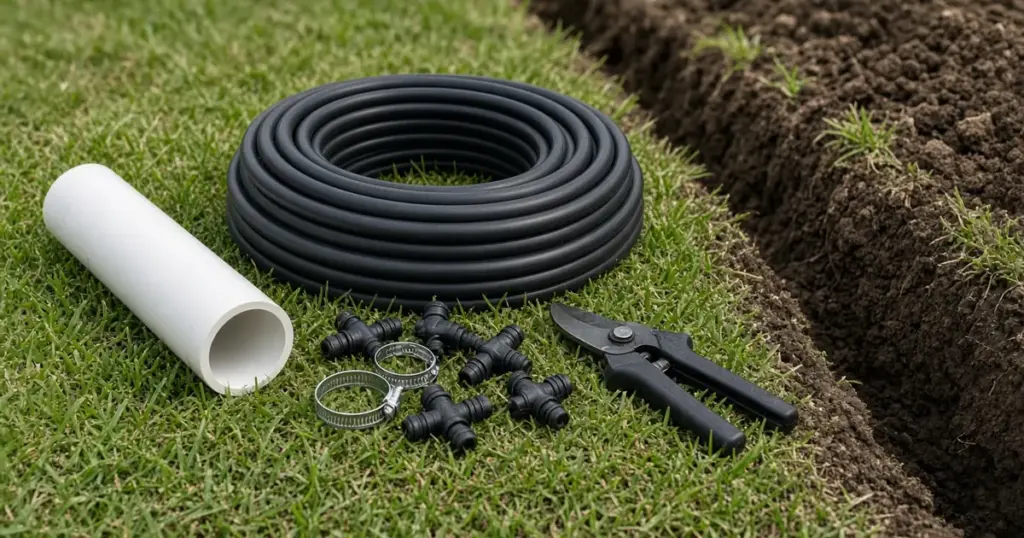
Dig down to a sprinkler line in two different yards and you might find two very different materials. One is a rigid white pipe joined with glued fittings. The other is a flexible black tube held together with barbed fittings and clamps. Both are common in irrigation, both work well when installed properly, and both fail in their own characteristic ways.
Knowing which one you have helps you understand why a leak happened, how it will be fixed, and what to watch for in the future. This article explains the differences for homeowners in Huntsville, TX and across Walker County.
The Two Main Pipe Types
PVC (polyvinyl chloride)
PVC is rigid, usually white, and joined with solvent-welded fittings: the pipe and fitting are primed, coated with cement, and pushed together so they fuse. Irrigation systems commonly use thinner-wall pressure-rated PVC for lateral lines and sometimes heavier-wall pipe for main lines or areas that need extra strength.
Strengths: Holds its shape, resists crushing, handles higher flow, and makes clean, permanent joints when glued correctly.
Weaknesses: Brittle when struck by a shovel or aerator tine, can crack when the ground shifts, and is more vulnerable to damage when water inside freezes in exposed sections.
For new PVC installations, Texas irrigation rules require a colored primer before applying PVC cement on fittings that rely on a chemical bond; TCEQ’s Questions and Answers for Irrigators explains the requirement. The visible primer color makes it easier to confirm a joint was primed.
Polyethylene (poly)
Poly pipe is flexible, usually black, and joined with insert fittings: barbed plastic fittings pushed into the pipe and secured with clamps. Because it bends, poly can follow curves and can sometimes be installed by pulling it through the soil instead of digging a full trench.
Strengths: Flexible, tolerates some ground movement, less likely to shatter from a shovel strike, and often more forgiving of freezing in buried sections.
Weaknesses: Barbed fittings and clamps can loosen or corrode over time, the pipe can be crushed or kinked, and it is easier to puncture with sharp objects. Insert fittings slightly reduce the inside diameter at each joint.
How to Tell Which One You Have
- Look at exposed sections near the backflow assembly, valves, or heads.
- Check the valve box. The pipe entering and leaving valves often shows the material.
- Look at the color. White or light gray is usually PVC; black is usually poly.
- Feel for flexibility. Poly bends easily; PVC does not.
- Look at the joints. Glued joints with primer residue suggest PVC; clamps around barbed fittings suggest poly.
Many older systems use both, especially if past repairs used whatever was on hand. Mixed systems can still work fine, but transitions between materials need the right adapter fittings.
How Each Type Typically Fails
PVC failures
- Cracks from impact, such as shovels, fence post digging, aerators, and vehicles on soft ground.
- Splits from ground movement where clay shifts with wet and dry cycles.
- Root pressure that cracks pipe or separates joints. Our existing article on how pine and hardwood roots damage irrigation lines covers this.
- Failed glue joints from poor priming, too little cement, or pipe not fully seated.
- Freeze cracks in shallow or above-ground sections.
Poly failures
- Loose or corroded clamps that let fittings weep or blow off.
- Cracked barbed fittings, especially older ones.
- Crushing and kinks from heavy equipment or roots.
- Punctures from stakes, edging, and digging.
How Repairs Differ
Repairing PVC
A typical PVC repair cuts out the damaged section and replaces it using couplings designed for repair, such as slip couplings that allow the pipe to be joined without pulling the line apart. The pipe ends must be cut square, cleaned, primed, and cemented, then given time to set before the line is pressurized. Keeping soil out of the pipe during the repair matters, because debris travels to heads and valves; it is the same reason we stress flushing the line in how to replace a broken sprinkler head.
Repairing poly
A poly repair usually cuts out the damaged section and inserts a barbed coupling, with stainless clamps on each side. Softening the pipe end can make insertion easier, and clamps must be properly tightened. If clamps on nearby fittings are corroded, replacing them during the repair can prevent the next leak.
For a full step-by-step look at how pipe repairs are carried out, our walkthrough on how a broken sprinkler pipe gets repaired goes deeper.
Local Soil and Pipe Choice
Around Huntsville, sandy loam sits on top of clay. Sand is easy to dig and backfill, but it can let pipe settle or shift if not compacted properly. Clay swells and shrinks with moisture, which puts stress on rigid pipe and joints. Roots from pines and oaks add pressure to both materials. Texas rules call for irrigation pipe to be buried to the manufacturer’s specified depth, or at least six inches of select backfill if no depth is published, which helps protect it from surface damage.
Finding Leaks in Either Material
Leaks in sandy soil may not surface where you expect, regardless of pipe type. Watch for pressure drops on a zone, unusually green strips, soft spots, and a moving water meter leak indicator when nothing is on. The sprinkler leak repair guide covers detection methods in detail.
When to Call a Pro
Call a professional if you are not sure what pipe you have, if a leak is on the main line, if repairs keep failing at the same spot, if you need to transition between pipe materials, or if the damaged section is under hardscape or tangled in roots. A licensed irrigator will use fittings rated for the pipe and pressure, keep debris out of the line, and pressure-test the repair. See our sprinkler repair page for pipe repairs and our emergency service page if a break is flooding the yard. If you are just starting to diagnose, the sprinkler troubleshooting guide can help.
Frequently Asked Questions
Is PVC or poly better for sprinkler systems?
Both work well when installed correctly. PVC is common for main lines and many laterals; poly is common where flexibility is useful. The best choice depends on the property, soil, and design.
Can PVC and poly be connected?
Yes, with the right adapter fittings. Transitions should be made carefully so they do not become weak points.
Why do my poly fittings keep leaking?
Corroded or loose clamps and aging barbed fittings are common causes. Replacing old clamps and fittings in the area often solves recurring leaks.
Pipe Leak? We Can Help
If you have a leaking line, call 346-586-6060 or request a repair. We repair both PVC and poly systems throughout Huntsville and Walker County.