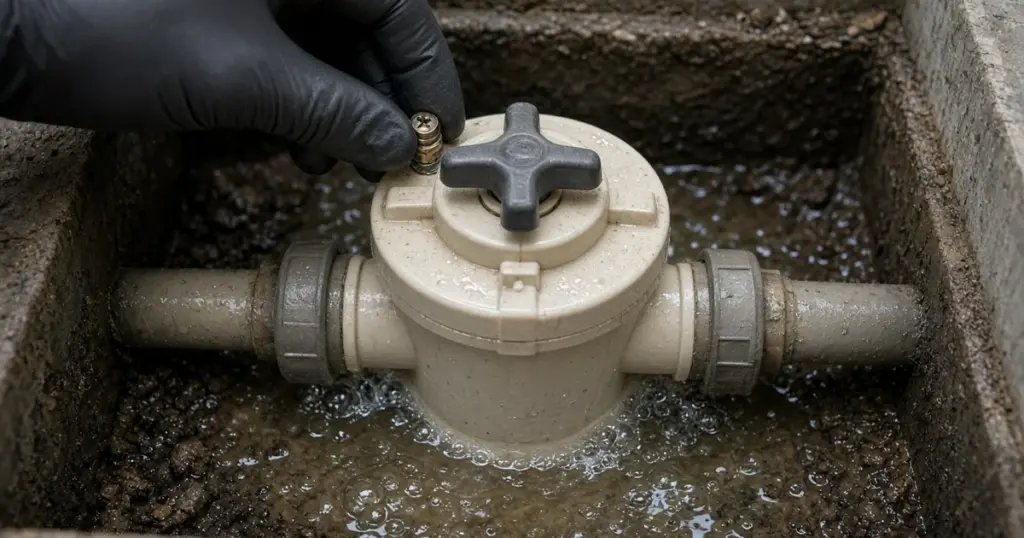
Most residential sprinkler valves have two small controls on top that many homeowners never touch: a manual bleed, which is a screw or lever that opens the valve without the controller, and a flow control, which is a handle or stem that limits how far the valve can open. Both are useful. The manual bleed lets you test a valve right at the box, which helps separate electrical problems from mechanical ones. The flow control lets you fine-tune a zone and can reduce water hammer.
Both can also cause confusion when they are left in the wrong position. A bleed screw left open keeps a zone running. A flow control turned all the way down keeps a zone from opening. This guide explains how each works, how to use them, and what they can tell you, with notes for systems around Huntsville, TX and Walker County.
How the Manual Bleed Works
A diaphragm valve stays closed because water pressure above the diaphragm pushes it down. Normally, the solenoid opens a small passage that releases that pressure, letting the diaphragm lift. Our guide to sprinkler valve diaphragm replacement explains the mechanism.
The manual bleed does the same thing by hand. It opens a passage that releases pressure from above the diaphragm, either externally, where a little water comes out at the valve, or internally, where water goes downstream into the zone.
Types of manual bleed
- External bleed screw: Turning it releases water out of the valve into the box.
- Internal bleed lever or screw: Turning it sends the bleed water downstream, so the box stays dry.
- Solenoid rotation: On some valves, turning the solenoid a quarter turn counterclockwise acts as a manual bleed.
Using the Manual Bleed to Test a Valve
- Find the valve for the zone.
- Open the bleed a turn or two, or move the lever.
- Listen and watch. The zone should start within a few seconds.
- Close the bleed to shut the zone off.
What the result tells you
| Result | Likely meaning |
|---|---|
| Zone opens manually but not from controller | Electrical problem: solenoid, wire, or controller |
| Zone does not open manually or electrically | Mechanical problem: diaphragm, debris, flow control closed, or no water supply |
| Zone opens and will not close after bleed is closed | Debris, damaged diaphragm, or bleed not fully closed |
If the problem is electrical, our article on testing and replacing a sprinkler solenoid is the next step.
How the Flow Control Works
The flow control is a handle or stem on top of the valve that limits how far the diaphragm can lift. Turning it clockwise reduces maximum flow; turning it counterclockwise allows more flow.
Uses for the flow control
- Fine-tuning a zone with high pressure.
- Reducing water hammer by slowing how quickly the valve closes. See water hammer and banging pipes.
- Shutting off a zone temporarily at the valve during a repair.
Cautions
- Turning it too far down can starve heads of pressure, causing poor coverage.
- Turning it all the way down can keep the valve from opening at all.
- After repairs, check that the flow control was not left closed.
Common Problems From Misused Controls
A zone that will not stop running
If someone opened the manual bleed to test a zone and did not close it fully, the zone may keep running. Check the bleed before assuming the valve has failed. Our existing post on a sprinkler zone that won’t shut off covers other causes.
A zone that will not open
A flow control turned all the way down can prevent opening. Back it out and test again.
A box full of water after testing
External bleed screws release water into the box. That is normal while testing; it should stop once the bleed is closed.
Step-by-Step: Setting a Flow Control
- Run the zone from the controller.
- Turn the flow control clockwise slowly while watching the heads.
- Stop when the spray pattern just starts to shrink.
- Back it out a little to restore full coverage.
- Confirm coverage across the whole zone.
Not every system needs this adjustment. If coverage is good and there is no hammer, leaving the flow control fully open is fine.
Using the Controls During Repairs
The flow control and manual bleed are handy during other repair work. Turning a zone’s flow control fully down can serve as a temporary shutoff for that zone while you replace a head, although the main line and valve stay pressurized, so be careful with the valve itself. The manual bleed is a quick way to run a zone while you stand at a broken head to watch for leaks, without walking back to the controller. Just remember to return both controls to their normal positions when you finish, and write down any changes so the next person working on the system knows what was done.
Tips for Working at the Valve
- Clear soil and debris from the top of the valve before turning anything.
- Do not force stiff screws or handles; plastic parts can break.
- Note the starting position of the flow control so you can return to it.
- Keep the solenoid tight, but not overtightened, after testing.
When to Call a Pro
Call a professional if a valve will not open with the manual bleed, if it will not close after the bleed is shut, if the bleed screw or flow control is broken, or if several valves behave strangely. A technician can rebuild or replace the valve and check the zone. The valves and wiring guide covers related topics. We repair sprinkler valves for homes across Huntsville and Walker County. See our sprinkler repair page and our services page.
Frequently Asked Questions
What does the manual bleed screw on my sprinkler valve do?
It opens the valve by hand, letting you test the zone without the controller.
Why does water come out of my valve when I turn the bleed screw?
External bleed valves release water into the box when opened. Close the screw and it should stop.
Should my flow control be fully open?
Often, yes. Reduce it only if you need to limit flow or reduce water hammer, and make sure coverage stays good.
Need Help at the Valve?
If a valve will not respond, call 346-586-6060 or schedule a repair.