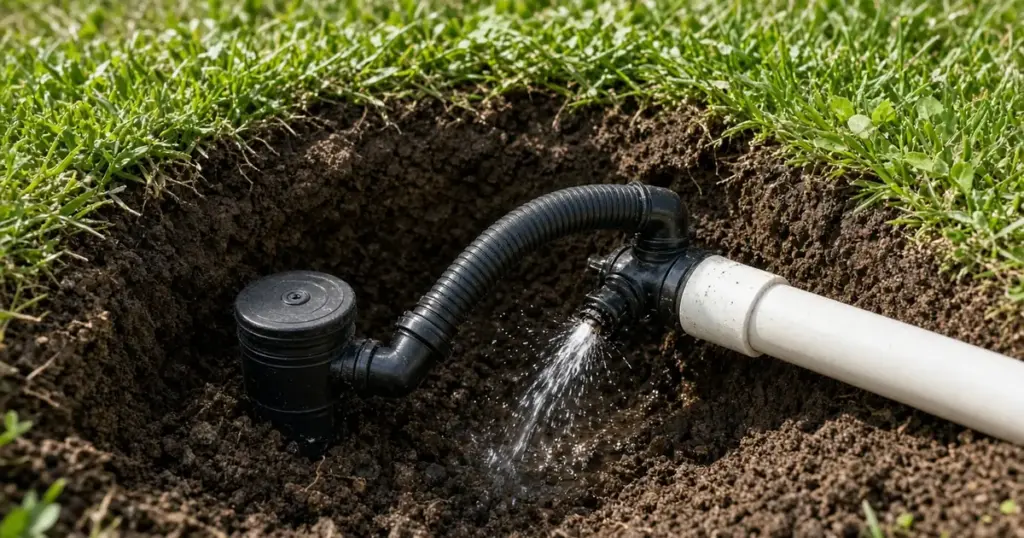
Between every sprinkler head and the lateral pipe that feeds it is a short connection that takes a lot of abuse. On many systems, that connection is a swing joint, a set of threaded elbows or a flexible pipe called funny pipe that lets the head sit at the right height and flex when it is stepped on or bumped by a mower. Swing joints are a big improvement over rigid risers, which snap easily. But they are not leak-proof. Fittings loosen, O-rings wear, funny pipe cracks, and barbs pull out.
A leak at a head connection often looks like a soggy spot right around one head, a puddle that forms only when that zone runs, or a head with weak spray. This guide explains how these connections work, why they fail, and how to fix them, with notes for systems in Huntsville, TX and Walker County.
Types of Head Connections
Rigid riser
A straight threaded pipe nipple between the lateral fitting and the head. Simple but fragile; any impact can snap it or crack the fitting below.
Funny pipe (flexible swing pipe)
A short length of flexible tubing connected with barbed or spiral-barb fittings at each end. It bends when the head is hit, absorbing impact. Easy to install and adjust height.
Rigid swing joint
A set of threaded elbows and a short nipple that rotate at the joints, letting the head move without breaking. Common on rotors and commercial systems.
Why Head Connections Leak
- Barbs pulling out of funny pipe after repeated stress.
- Cracked funny pipe from age, sun exposure before burial, or freezing.
- Loose threaded fittings on swing joints.
- Worn O-rings in rigid swing joints.
- Cracked tees at the lateral from impact.
- Roots pushing against the connection.
- Over-tightened plastic threads that crack.
Mower and vehicle impacts are a frequent cause. See preventing mower damage to sprinkler heads.
Signs of a Head Connection Leak
- Water bubbling up around the base of a head when the zone runs.
- A soggy patch centered on one head.
- Weak spray at that head compared with others on the zone.
- A head that tilts easily or wobbles.
- Water pooling near a head after the zone shuts off, which may also be low-head drainage.
Finding the Leak
- Run the zone and watch the suspect head.
- Turn the zone off and dig carefully around the head.
- Expose the connection down to the lateral pipe.
- Run the zone briefly with the connection exposed to see where water comes out.
Our sprinkler leak repair guide covers other leak-finding methods.
Repairing the Connection
Funny pipe repairs
- Shut off the zone.
- Cut out the damaged section or replace the whole piece of funny pipe.
- Install new barbed fittings fully into the pipe.
- Check the tee or fitting at the lateral and replace it if cracked.
- Reconnect the head at the correct height.
- Flush before reinstalling the nozzle.
- Test before backfilling.
Rigid swing joint repairs
- Unscrew the joint and inspect each piece.
- Replace worn O-rings or cracked elbows.
- Reassemble without over-tightening.
- Test for leaks.
Rigid risers
Replace snapped risers, and consider converting to funny pipe or a swing joint so the head can flex next time.
Cracked lateral fitting
If the tee at the lateral is cracked, the pipe may need to be cut and a new fitting installed. Our guide to repairing a broken sprinkler pipe walks through it.
Setting Head Height During Repair
Repairs are a good time to fix head height. The top of the head should sit flush with the soil. Our existing article on why sprinkler head height matters explains why. If you replace the head, see how to replace a broken sprinkler head.
Backfilling After the Repair
Once the connection is fixed and tested, backfill carefully. Hold the head straight and at the right height while you add soil around it, and compact the soil in layers with your hand or a tamping tool. Loose backfill lets the head sink or lean over the next few weeks, which puts it back in the path of mowers. Replace the sod plug and water it in.
Preventing Future Leaks
- Use swing joints or funny pipe instead of rigid risers.
- Keep heads at the correct height so mowers do not hit them.
- Compact soil around heads after repair so they stay straight.
- Protect heads near driveways and walkways.
- Inspect connections when a head starts to wobble or tilt.
Funny Pipe Quality and Fittings
Not all flexible swing pipe and fittings are the same. Use pipe and fittings designed to work together, and push barbed fittings fully into the pipe. Some fittings use a spiral barb that screws in rather than pushes in. If a fitting pulls out under pressure, replace both the fitting and the end of the pipe rather than pushing the same fitting back in.
When One Head Keeps Leaking
If the same head connection leaks repeatedly, look for the cause rather than repeating the repair. Common culprits include a head placed where tires or foot traffic hit it, a root pushing against the connection, soil that keeps settling around the head, or pressure high enough to stress the fittings. Moving the head a short distance, rerouting the funny pipe, or adding pressure regulation to the zone often ends the cycle.
When to Call a Pro
Call a professional if several heads leak at their connections, if the lateral fitting is cracked, if leaks keep recurring, or if you would rather not dig. A technician can repair connections, reset heights, and convert rigid risers to flexible connections. We repair head connections for homes across Huntsville and Walker County. See our sprinkler repair page and our services page.
Frequently Asked Questions
What is funny pipe in a sprinkler system?
It is flexible tubing that connects a sprinkler head to the lateral pipe, letting the head flex when hit and making height adjustment easy.
Why is water bubbling up around my sprinkler head?
A leak at the head’s connection, such as a cracked fitting or a barb that pulled out of funny pipe, is a common cause.
Should I replace rigid risers with swing joints?
Often, yes. Swing joints and funny pipe absorb impact and are less likely to break than rigid risers.
Fix Leaks at Your Heads
If your heads are leaking at their connections, call 346-586-6060 or schedule a repair.