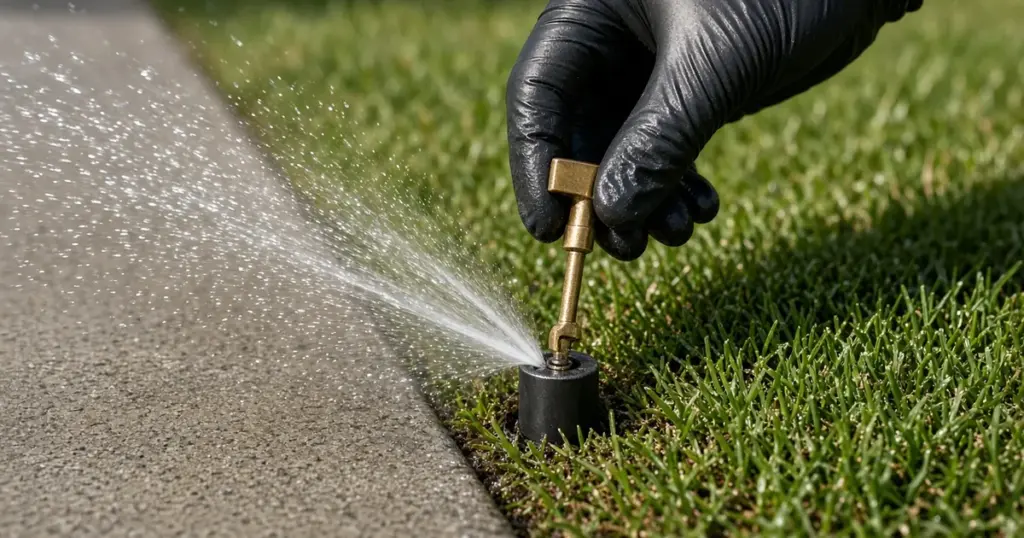
Walk past a few houses on a summer morning and you will see it: sprinklers soaking the driveway, misting the siding, or throwing water into the street while a corner of the lawn stays dry. Most of the time, the fix does not require new parts. It takes a few minutes, the right tool, and an understanding of how your heads adjust.
Around Huntsville, where many lots are compact and lined with driveways, walks, and fences, overspray is one of the most common irrigation problems. This guide covers adjusting the two most common types of heads, spray heads and rotors, along with when adjustment is not enough and a nozzle change makes more sense. Texas irrigation standards prohibit spraying water onto impervious surfaces like concrete, streets, and walls, so getting this right is also about meeting the rules, not just saving water.
Before You Start
Run the zone and watch each head. Note:
- Heads hitting pavement, walls, fences, or windows.
- Heads that leave gaps between their pattern and the next head.
- Heads that are tilted, which throws water unevenly.
- Heads blocked by grass, shrubs, or decorations.
Fix tilted and blocked heads first; if a head is cracked rather than just crooked, replace it using the steps in how to replace a broken sprinkler head. If a head is sunk below grade or tilted, see why sprinkler head height matters. Adjusting the pattern of a crooked head will not solve the problem.
Understanding Arc and Radius
- Arc is the angle the head covers, from a narrow strip to a full circle.
- Radius is how far the water throws.
- Direction is where the arc starts and stops.
Good coverage usually means head-to-head spacing: each head’s spray reaches the next head. Texas standards say spacing should not exceed the manufacturer’s published radius at the operating pressure.
Adjusting Spray Heads
Most spray heads use interchangeable nozzles. There are two main nozzle types.
Fixed-arc nozzles
These come in set patterns, such as quarter, half, and full circle, and are color-coded or labeled.
To change direction: With the zone running, or with the riser pulled up, turn the riser body to point the arc where you want it. Many risers have a ratchet that allows rotation.
To change radius: Turn the adjustment screw on top of the nozzle clockwise to reduce throw. Do not reduce it too much, because heavy reduction distorts the pattern and can make droplets uneven.
To change arc: Swap the nozzle for one with the right pattern.
Variable-arc nozzles
These let you set the arc anywhere within a range by twisting the top of the nozzle.
- Pull up the riser or run the zone.
- Turn the riser to set one edge of the pattern.
- Twist the nozzle collar to open or close the arc to the other edge.
- Adjust the radius screw if needed.
Spray head tips
- Matching nozzles on a zone matters. Mixing nozzle series with different precipitation rates leads to wet and dry areas.
- If spray mists or fogs, the problem is pressure, not adjustment. Pressure-regulated heads or nozzles help.
- A head right next to pavement should be a part-circle pattern pointing away from it. Texas standards require spray heads and rotors next to hardscape to direct flow away from the surface and be installed at least four inches from it.
Adjusting Rotors
Rotors are gear-driven heads that rotate a stream back and forth. Adjustment methods vary by brand, so check the markings on top of the head or the manufacturer’s instructions.
Setting direction and arc
Most rotors have a fixed left (or right) stop and an adjustable opposite stop.
- Find the fixed edge. Turn the turret by hand to locate the fixed stop. Rotate the whole head or body so this edge lines up with one boundary, such as a sidewalk.
- Set the arc. Use the brand’s adjustment key or a flat screwdriver in the arc adjustment slot to widen or narrow the pattern.
- Watch a full rotation to confirm both edges land where you want.
Never force a rotor turret against its stops. Turning it the wrong way can strip the gears. If a rotor sprays but does not rotate, see rotor sprinkler head not rotating.
Setting radius
Rotors typically have a radius reduction screw that lowers the stream into the water flow. Reducing it a little is fine. Reducing it a lot distorts the stream; changing to a smaller nozzle is often better.
Changing rotor nozzles
Rotors come with several nozzles sized by flow. Heads covering a full circle should use larger nozzles than heads covering a quarter circle, so they apply water at a similar rate. That is called matched precipitation, and it is one of the most overlooked parts of rotor setup.
When Adjustment Is Not Enough
- A head is in the wrong place. If a head sits too close to pavement or a wall, moving it may be the only real fix.
- The zone has mixed head types. Sprays and rotors apply water at very different rates and should not share a zone.
- Pressure is too high or low. Adjustments cannot fix misting or weak throw.
- Narrow strips. For new systems, Texas rules prohibit above-ground spray in strips under 48 inches wide bordered by pavement on two or more sides. Drip is usually the better choice there.
The sprinkler troubleshooting guide covers these issues by symptom, and the efficient irrigation guide explains why fixing overspray saves water.
A Simple Adjustment Routine
- Run one zone at a time.
- Fix tilted, sunken, and blocked heads.
- Adjust direction and arc so no water lands on hardscape.
- Check radius so spray reaches the next head.
- Confirm nozzles match across the zone.
- Repeat for each zone, then check after major landscape changes.
When to Call a Pro
Call a professional if heads need to be moved or added, if a zone mixes sprays and rotors, if pressure problems cause misting or weak throw, or if coverage gaps persist after adjustments. In Huntsville and across Walker County, we adjust, replace, and rebalance heads so zones water evenly. See our sprinkler repair page and our services page.
Frequently Asked Questions
How do I stop my sprinkler from hitting the house?
Rotate the head or change to a part-circle nozzle so the pattern points away from the wall. If the head is too close to the house, it may need to be moved.
Can I adjust a sprinkler head without turning on the water?
Many spray heads can be adjusted by pulling up the riser. Rotors and final checks are easiest with the zone running so you can see the pattern.
Why does reducing the radius make my spray uneven?
Large reductions disrupt the stream. Use a nozzle with a smaller radius instead.
Need Help Dialing It In?
If your zones still water the driveway after adjustments, call 346-586-6060 or book a visit, and we will set every head for even coverage.