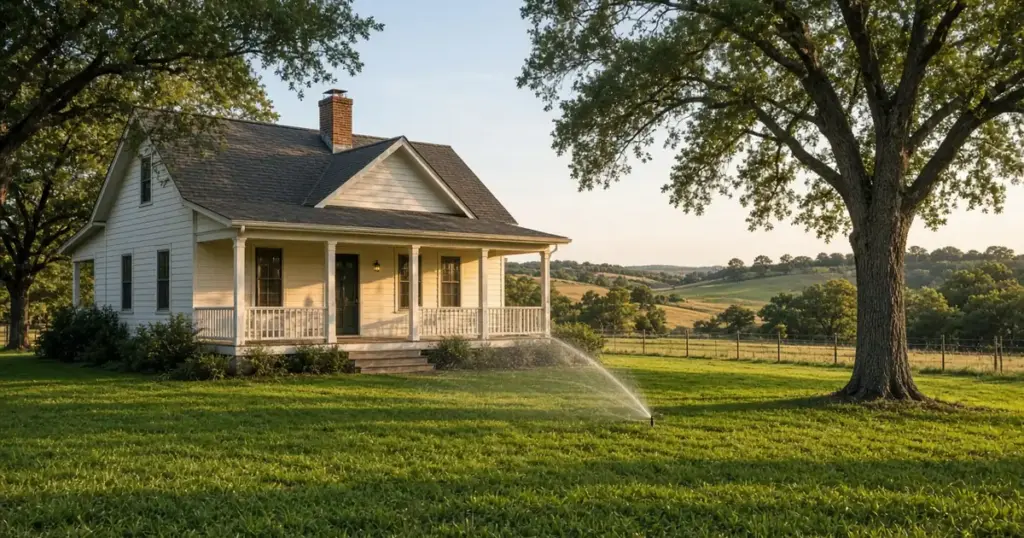
Head north from Huntsville on Interstate 45 and you reach Madisonville, the seat of Madison County. The town and its surroundings mix established in-town neighborhoods, newer homes on the outskirts, and ranch and farm properties stretching out in every direction. Sprinkler systems here range from compact front-yard setups to large, spread-out systems on acreage.
This guide covers the irrigation issues Madisonville homeowners commonly face, the water supply questions that shape repairs, and how to keep a system running through Texas heat and the occasional hard freeze.
In-Town Lots
Systems on smaller in-town lots tend to have the familiar mix of problems:
- Broken heads near driveways and sidewalks from vehicles and mowers.
- Sunken heads as soil settles and turf thickens.
- Overspray onto walks and streets, which wastes water and is prohibited under Texas irrigation standards.
- Valve and solenoid failures, often during summer peak use.
- Controller schedules that never change with the seasons.
Most of these are straightforward to diagnose. Our sprinkler troubleshooting guide organizes them by symptom, including overspray onto walks and streets.
Newer Homes on the Outskirts
Newer houses built on the edges of town often come with a builder-installed system designed mainly to establish sod. Those systems can serve well for years, but they usually benefit from a tune-up after the first couple of seasons:
- Separate lawn and bed programs so shrubs are not watered like turf.
- Match nozzles within each zone so coverage is even.
- Raise heads that have sunk as the new soil settles.
- Add or verify a rain sensor, which Texas rules require on new automatic systems.
- Check the backflow assembly and keep a copy of its first test report.
Construction traffic also compacts soil, so water tends to run off. Shorter cycles with soak time in between let it soak in instead.
Acreage and Ranch Properties
On larger properties, irrigation usually covers the lawn and beds around the house, while pastures and fields are left alone. Common concerns:
- Long main lines with more room for leaks to go unnoticed.
- Scattered valves that are hard to find after years of landscaping and fence work.
- Livestock, equipment, and vehicles crossing irrigated areas and breaking heads.
- Edge heads throwing water into pasture, which can be fixed with part-circle patterns and adjusted radius.
Water Supply: City, Rural, or Well
Madisonville-area properties may be on city water, a rural water supply system, or a private well. Each affects irrigation:
- City and rural water providers set their own backflow testing requirements and drought restrictions. Check with yours for current rules.
- Private wells limit zone size to pump capacity, may introduce sediment or iron, and give no water bill to warn about leaks.
Whatever the source, backflow protection is required when irrigation connects to potable water. Rural homes on septic systems should know that TCEQ guidance calls for a reduced pressure principle assembly on irrigation systems connected to a potable supply at properties with an on-site sewage facility. The backflow prevention and testing guide explains assembly types, and our existing article on well-water irrigation systems covers pumps and filtration.
Soil: Check What You Actually Have
Soils vary across Madison County, so it is worth looking rather than assuming. Dig a small hole in a few spots and note whether the soil is sandy, loamy, or clay-heavy, and how deep the topsoil goes. Sandy soil drains fast and may need shorter, more frequent cycles; clay holds water and needs cycle-and-soak to prevent runoff. The lawn and soil irrigation guide explains how soil type changes scheduling.
Weather Patterns to Plan Around
- Long, hot summers push systems to their limit. Early-morning watering and cycle-and-soak help.
- Storms and power outages can reset controllers. Battery backups and post-storm checks help.
- Occasional hard freezes threaten above-ground backflow assemblies and exposed pipe.
- Heavy rain events call for a working rain sensor and a quick inspection afterward.
Common Madisonville Repairs
- Broken, tilted, or sunken heads.
- Overspray onto hardscape.
- Leaks in lateral and main lines.
- Valve and solenoid problems.
- Wiring damage from fence and landscape work.
- Pump-related pressure problems on well systems.
- Freeze-damaged backflow assemblies.
A Seasonal Routine That Works Here
- Spring: Run every zone, fix broken and sunken heads, test the rain sensor, and set a spring schedule.
- Summer: Water early, split long run times into cycles, and check zones every couple of weeks during heat waves.
- Fall: Cut run times and watering days as temperatures drop, and clear leaves from heads and valve boxes.
- Winter: Insulate the backflow assembly before hard freezes and switch off automatic watering on freezing nights.
The year-round maintenance calendar covers each season in more detail.
Keeping a Simple System Record
Whether your system is small or large, a basic record makes repairs faster: a list of zones and what they cover, valve locations, head types, controller settings by season, and the date of your last backflow test. Keep it with your property documents.
When to Call a Pro
Call a professional if water runs continuously, if a zone stays dead after controller checks, if you suspect a leak from a rising bill or a pump that runs too often, if a freeze damaged the backflow assembly, or if you need backflow testing. On larger properties, a technician with locating and testing tools can save a lot of exploratory digging. We serve Madisonville along with Huntsville and the rest of Walker County and surrounding areas. See our service areas page and our sprinkler repair page. For nearby towns, see our guide to Huntsville and the surrounding East Texas towns.
Frequently Asked Questions
My sprinklers water the street. Is that a problem?
Yes. Texas irrigation standards prohibit spraying water onto impervious surfaces like streets and sidewalks, and it wastes water. Adjusting or replacing heads usually fixes it.
How often should I check a large irrigation system?
A full walk-through each spring and a quick check of each zone every few weeks in summer catch most problems early.
Do I need backflow testing if I am on a rural water system?
Testing is required at installation and after repairs, and many providers require periodic tests. Ask your water provider for its schedule.
Sprinkler Help in Madisonville
For repairs or a seasonal check on your Madisonville property, call 346-586-6060 or request service online.