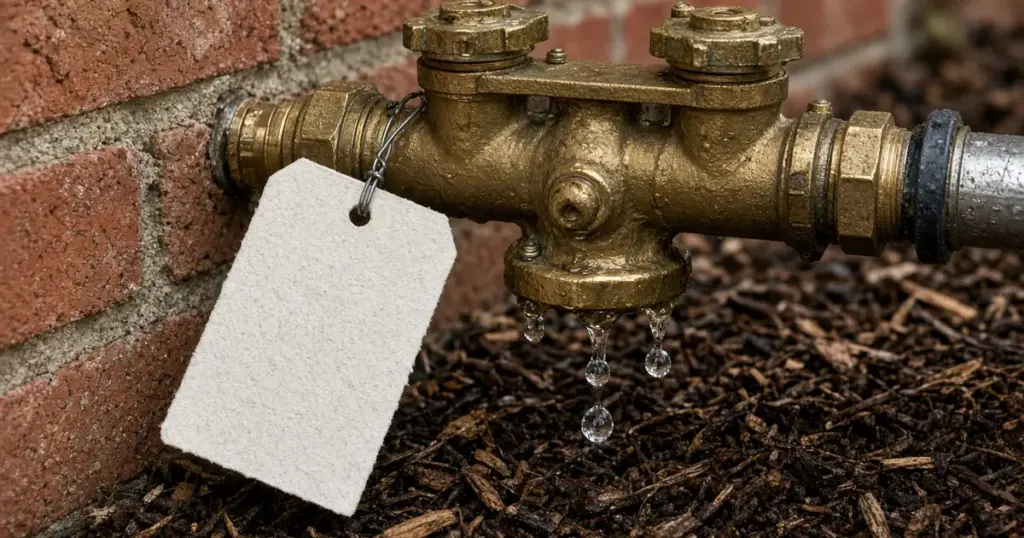
A failed backflow test sounds alarming, but it is a routine part of owning an irrigation system. Backflow assemblies have moving parts, rubber seals, and springs that wear and collect debris. A failed test simply means that one or more parts did not perform within the limits the test measures. The assembly needs attention before it can be counted on to protect the drinking water supply.
This article explains what a failure means, why assemblies commonly fail, what happens next, and how to keep the process moving smoothly with your water provider. It is written for property owners in Huntsville, TX and across Walker County.
What a Backflow Test Measures
A licensed backflow prevention assembly tester connects a test kit to the assembly’s test cocks and checks how each component performs. Depending on the assembly type, that includes whether check valves hold tight, whether a relief valve opens at the right point, or whether an air inlet opens and closes properly. Our article on what happens during a backflow test describes the procedure step by step.
A failure means at least one of those readings fell outside the acceptable range, or the assembly could not be tested because of a problem like a stuck shutoff valve.
Common Reasons Assemblies Fail
Debris
Sand, pipe shavings, or sediment can lodge on a check valve seat and keep it from sealing. This is especially common after line repairs or on well systems. Sometimes cleaning is all that is needed.
Worn rubber parts
Check discs, diaphragms, and O-rings harden or deform over time.
Weak springs
Springs that hold check valves closed can lose tension.
Freeze damage
Cracks or distortion from freezing can cause leaks and failures. Our existing article on backflow preventer problems in Huntsville covers freeze damage and other warning signs.
Shutoff valve problems
If an assembly’s shutoff valves do not close fully, the tester may not be able to complete the test accurately.
Installation issues
An assembly installed incorrectly, such as a pressure vacuum breaker located below the highest downstream head, may not perform properly. TCEQ guidance requires a PVB to be installed at least 12 inches above the highest downstream piping and heads.
What Happens Next
Step 1: Understand the result
Ask the tester which component failed and what they recommend. The test report records the readings and the result.
Step 2: Decide on repair or replacement
Many failures can be fixed by cleaning or rebuilding the assembly with a manufacturer’s repair kit. Others, like a cracked body or obsolete parts, call for replacement. Our guide to backflow preventer rebuild vs. replacement explains how that decision is made.
Step 3: Make the repair
Repairs to backflow assemblies should be performed by a licensed professional. Homeowners should not disassemble an assembly themselves.
Step 4: Retest
Under TCEQ rules, an assembly must be tested after repair, replacement, or relocation. The retest confirms the repair worked.
Step 5: Submit the paperwork
TCEQ guidance states that test results must be provided to the water purveyor within 10 business days. Your tester typically submits the report, but confirm who is handling it. In Huntsville, the city has used an online test-tracking service for new device records, and the customer service agreement places responsibility for maintaining required devices and records on the customer.
Is It Safe to Keep Watering?
A failed assembly may not provide the protection it is supposed to. The safest course is to follow the tester’s guidance and your water provider’s requirements. In many cases, owners keep irrigation off until the repair and retest are complete. If the assembly is leaking, closing the irrigation supply stops the leak while keeping house water on.
Choosing the Right Assembly Type
Sometimes a failure reveals that the assembly is not the right type for the property. For example, TCEQ guidance calls for a reduced pressure principle assembly where chemicals are injected into the irrigation system or where a property has an on-site sewage facility and irrigation is connected to potable water. If the property has changed, the assembly may need to change too. See PVB vs. RPZ vs. double check for the differences.
Keeping Records
Keep a copy of every test report, repair invoice, and retest result in one place. Records help in several ways: they show whether an assembly is failing repeatedly, they answer questions from your water provider quickly, and they are useful when you sell the property.
How to Reduce Future Failures
- Protect the assembly from freezes with insulation or a cover, and drain it when appropriate.
- Flush lines after repairs before reconnecting the assembly, when possible, to keep debris out.
- Keep the assembly accessible so it can be tested and serviced.
- Protect it from impact with a guard or by moving it out of the mower path.
- Address leaks quickly. A dripping assembly often fails its next test.
The backflow prevention and testing guide covers prevention and requirements in more depth.
When to Call a Pro
If your assembly failed a test, a licensed tester and irrigation professional should handle the repair and retest. Call promptly if the assembly is leaking, if your water provider has sent a notice about a missing or failed test, or if you are not sure your assembly is the right type for your property. We help property owners in Huntsville and Walker County get assemblies repaired, replaced, retested, and documented. See our sprinkler repair page and our services page.
Frequently Asked Questions
Does a failed backflow test mean my water is contaminated?
No. A failed test means the assembly did not meet test standards, not that backflow occurred. It does mean the assembly needs repair to provide reliable protection.
How quickly do I need to fix a failed assembly?
Follow your water provider’s requirements and deadlines. Prompt repair keeps your system compliant and protected.
Can a failed assembly pass after cleaning?
Often, yes. Debris on a check seat is a common cause, and cleaning followed by a retest may resolve it.
Who sends the test results to the city?
The tester typically submits the report, but the property owner is responsible for making sure it is filed. Ask your tester to confirm.
Get Your Assembly Back in Compliance
If your backflow assembly failed its test, call 346-586-6060 or request service.