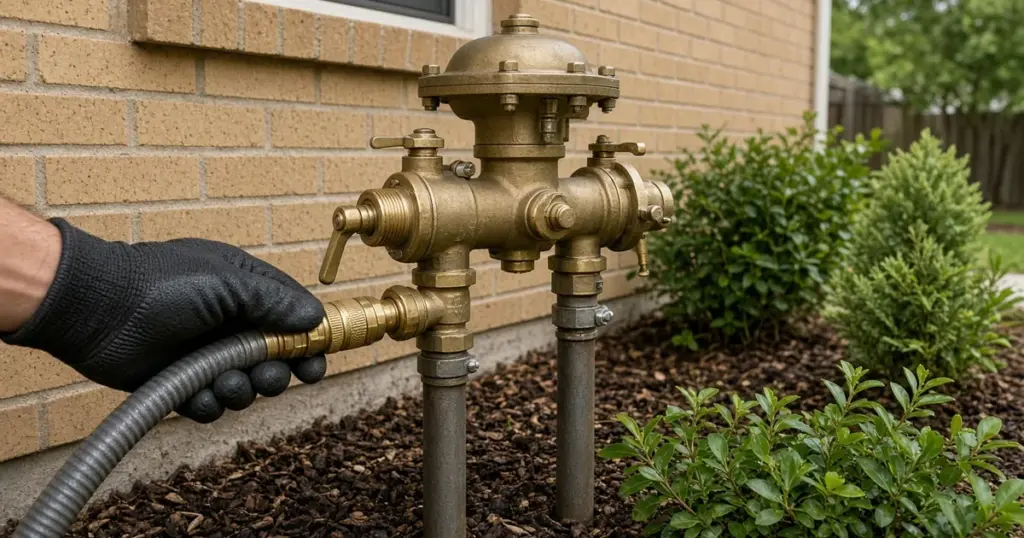
Your sprinkler system and your kitchen faucet usually share the same water supply. Most of the time, water flows one way: from the main, through your meter, and out to the lawn. But pressure in a water system can change suddenly, from a main break, firefighting, or a pump issue, and when it does, water can try to run backward. Without protection, water that has been sitting in buried irrigation pipe, in contact with soil, fertilizer, and whatever else is on the lawn, could be pulled back toward the drinking water supply.
A backflow prevention assembly is the device that stops that from happening. This guide explains how those assemblies work, what Texas rules require, how testing works for Huntsville, TX and Walker County properties, and what owners on private wells should know.
What Backflow Is and Why Irrigation Is a Risk
Backflow happens in two ways:
- Back-siphonage, when pressure on the supply side drops, creating suction that pulls water backward.
- Backpressure, when pressure on the irrigation side becomes higher than the supply, pushing water backward.
Irrigation is a classic cross-connection because sprinkler heads sit at or below the soil surface. Water in the lateral lines is considered non-potable. The Texas Commission on Environmental Quality’s Consumer’s Guide to Backflow Prevention states plainly that lawn sprinkler systems must be connected through a backflow-prevention assembly.
What Texas Rules Require
TCEQ’s landscape irrigation rules require an appropriate backflow prevention method on irrigation systems connected to a potable supply, and they set testing requirements. According to TCEQ guidance, backflow prevention assemblies must be tested by a licensed backflow prevention assembly tester when installed, and the agency’s cross-connection control page notes that your water provider may require annual testing as well. Assemblies on irrigation systems designated as health hazards, such as systems that inject chemicals, must be tested every year.
Two practical takeaways:
- A new, repaired, replaced, or relocated assembly needs a test by a licensed tester before it goes into normal service.
- Your water provider can set stricter rules than the state, so the provider’s requirements are the ones to follow.
For a walk-through of what the tester actually does with the gauges and test cocks, see what happens during an irrigation backflow test.
How Huntsville Handles Backflow Records
The City of Huntsville’s utility service agreement makes the customer responsible for installing, testing, and maintaining any backflow prevention device the city requires, and for providing copies of testing and maintenance records to the city. The city has also used an online tracking system for registered testers to submit results for new devices. If you are inside city limits, your tester should know the current submission process. Rules can change, so check with the city’s utilities department if you are unsure what applies to your property.
Customers of other water systems in the region, such as nearby cities, special utility districts, and water supply corporations, should ask their provider about its own cross-connection program.
Types of Backflow Assemblies on Local Systems
Residential irrigation systems typically use one of three assembly types:
- Pressure vacuum breaker (PVB), installed above ground and above the highest head.
- Reduced pressure zone assembly (RPZ or RP), the highest level of protection, required where health hazards exist.
- Double check valve assembly (DCVA), allowed in some non-health-hazard situations where local rules permit it.
The differences in protection, installation, and freeze exposure are covered in PVB vs. RPZ vs. double check.
Common Backflow Problems
Our earlier post on backflow preventer problems in Huntsville lists the warning signs: dripping, weak pressure, odd noises, and visible damage. A few problems come up again and again in this area:
- Freeze damage. Above-ground assemblies are exposed, and a hard freeze can crack bodies and bonnets. See protecting irrigation and backflow from winter freezes.
- Debris on check seats. Sand and grit keep checks from sealing, which can cause a failed test or constant dripping from an RPZ relief valve.
- Worn rubber parts. Seals and springs wear with age and can often be replaced with a repair kit.
- Physical damage and theft. Brass assemblies near the street are vulnerable to mowers, vehicles, and theft. Backflow covers and enclosures can help.
When a Test Fails
A failed test does not necessarily mean the assembly needs replacing. Often a cleaning and a repair kit fix the problem, followed by a retest. Sometimes the body is damaged or parts are no longer available, and replacement makes more sense. We explain the decision in backflow preventer rebuild vs. replacement and the overall process in failed backflow test next steps.
Private Wells and Irrigation in Walker County
Many properties outside city limits in Walker County use private wells. Irrigation from a well brings its own considerations: pump capacity, pressure tank cycling, sediment, and iron. Our existing guide to well-water irrigation systems in Walker County is a good starting point. For pump and pressure tank questions, read running sprinklers on a well pump. If orange stains are appearing on your siding and sidewalks, iron staining from well-water sprinklers explains causes and options.
Backflow protection still matters on a well. The well supplies your household water, so contamination from the irrigation side is a risk to your own family. Inside Huntsville city limits, note that the city’s Unified Development Ordinance states that irrigation water supply wells are prohibited in the city limits. Our article on running sprinklers from a private well in Walker County covers what to check before drilling or connecting a well.
When to Call a Pro
Testing and repair of backflow prevention assemblies must be done by a TCEQ-licensed backflow prevention assembly tester. Call a professional if the assembly is leaking, if water sprays from the relief valve of an RPZ, if a test is due or has failed, or if you are adding or relocating an assembly. Freeze damage to the assembly should also be handled promptly, because the system cannot be safely used until it is repaired and tested. See our services page for the backflow and irrigation work we handle, and our sprinkler repair page for related repairs.
Frequently Asked Questions
How often does my irrigation backflow need to be tested?
At minimum, TCEQ requires a test when the assembly is installed, repaired, replaced, or relocated, and every year if the system is designated a health hazard. Many water providers require annual testing for all irrigation assemblies, so check with yours.
Can I test my own backflow preventer?
Testing must be done by a licensed backflow prevention assembly tester using calibrated equipment, and results go to the water provider. A homeowner can visually inspect for leaks and damage between tests.
Does a well-only irrigation system need backflow protection?
If the irrigation system connects to the same well and plumbing that supplies your home, backflow protection is important to keep irrigation water out of your drinking water. Your irrigator can recommend the appropriate assembly.
Schedule Backflow Testing or Repair
If your assembly is due for testing, has failed, or is visibly damaged, call 346-586-6060 or request service online. We help property owners throughout Huntsville and Walker County keep their irrigation systems safe and compliant.