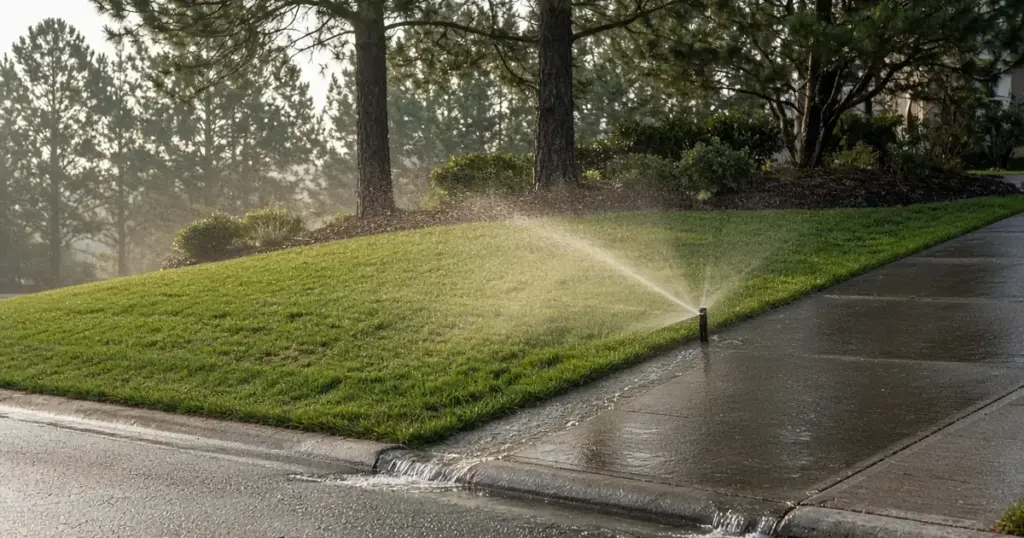
Water running down the gutter on a sunny morning is a familiar sight in many neighborhoods. It usually comes from one of two problems. Overspray is water thrown past the edge of the lawn onto sidewalks, driveways, streets, and walls. Runoff is water that hits the lawn but cannot soak in fast enough, so it flows off, often down a slope. Both waste water and money, and both can cause slippery walks, stained concrete, erosion, and soggy low spots.
The good news is that most overspray and runoff problems can be fixed with adjustments and modest upgrades. This guide explains how, with notes for the layered soils and sloped lots common around Huntsville, TX and Walker County.
Overspray: Water Going Where It Should Not
Common causes
- Heads aimed past the edge of the lawn.
- Arcs set too wide, such as a full-circle head next to a walk.
- Radius set too long for the area.
- Tilted heads that throw water at an angle.
- High pressure that causes misting and drift.
- Wind carrying spray off target.
- Heads too close to hardscape.
Texas standards
TCEQ guidance for new installations requires heads to be at least 4 inches from hardscape and directed away from it, and prohibits spray onto impervious surfaces. New systems also cannot use above-ground spray in landscapes less than 48 inches wide that are bordered by pavement on two or more sides. Older systems may not meet those standards, but they are a good target when adjusting or upgrading.
Fixes
- Adjust the arc and radius of each head. Our guide on how to adjust sprinkler spray patterns walks through the steps.
- Straighten tilted heads.
- Replace nozzles with the right arc for each location: quarter, half, or strip nozzles along edges.
- Reduce pressure with pressure-regulating heads or a regulator. See pressure-regulating sprinkler heads.
- Move heads back from hardscape where possible.
- Convert narrow strips to drip or remove spray from them.
Runoff: Water That Cannot Soak In
Common causes
- Application rate higher than soil intake. Spray heads apply water quickly.
- Clay soil or layered soil with clay close to the surface. Our article on sandy loam over clay explains why runoff starts partway through a cycle.
- Slopes, where water flows downhill before it soaks in.
- Compacted soil that resists water entry.
- Long run times in a single cycle.
Fixes
- Use cycle-and-soak. Split run times into shorter cycles with soak periods between. This is often the single most effective fix.
- Switch to lower-rate nozzles, such as rotary nozzles, on slopes and clay.
- Separate the top and bottom of slopes into different zones when possible. The top dries faster; the bottom collects water.
- Install check valves in heads at the bottom of slopes to stop drainage after the zone shuts off.
- Aerate compacted soil to improve water entry.
- Measure output with a catch-cup test to set run times by depth.
Finding the Problem Zones
Walk the yard during each zone’s cycle. Note:
- Where water hits pavement or walls.
- When runoff starts in the cycle.
- Where water collects after the cycle.
- Which heads mist or drift.
Do this on a calm morning and again on a windy one if possible.
Slopes Deserve Special Attention
Sloped yards concentrate all the problems: runoff, drainage from low heads, and dry upper areas. Practical steps:
- Point heads uphill or across the slope rather than downhill where practical.
- Use matched-precipitation nozzles within each zone.
- Shorten cycles and add more of them.
- Consider groundcovers or drip-watered beds on steep slopes that are hard to mow and water.
Low-Head Drainage on Slopes
Some water seen at the bottom of a slope after watering is not runoff at all. When a zone shuts off, water left in the pipe drains out of the lowest heads, which can leave a puddle long after the cycle ends. Check valves installed in those heads hold water in the line and stop the draining.
Why It Matters for Your Water Bill
Overspray and runoff represent water you pay for that never reaches roots. Fixing them often lets you shorten run times because more of the water you apply actually soaks in. The lower water bill guide covers other efficiency improvements. Our existing post on why sprinkler head height matters explains how low heads distort spray.
A Weekend Plan for Fixing Overspray and Runoff
If you want to tackle the problem in one session, this order works well:
- Morning walk-through. Run every zone and flag each head that sprays pavement, mists, or sits crooked. Note where runoff starts and how many minutes into the cycle.
- Quick adjustments. Straighten heads, adjust arcs and radius, and clean any clogged nozzles.
- Nozzle swaps. Replace nozzles that cannot be adjusted to fit their spot, using strip, quarter, or half patterns as needed.
- Controller changes. Split run times into cycles with soak periods, and shorten zones that ran off early.
- Follow-up check. Run each zone again the next morning to confirm.
Write down what you changed so you can return to it if something looks wrong later.
Neighborhood and Watering Rules
When drought stages are declared, overspray and runoff draw attention. Many drought plans restrict wasteful watering. Keeping water on the lawn is the simplest way to stay on the right side of any watering rules your provider sets.
When to Call a Pro
Call a professional if you cannot stop overspray with adjustments, if runoff persists after cycle-and-soak, if heads need to be relocated away from hardscape, or if slopes need to be re-zoned. A licensed irrigator can redesign problem areas to current standards. We help homeowners across Huntsville and Walker County fix overspray and runoff. See our sprinkler repair page and our irrigation installation page.
Frequently Asked Questions
Why does water run off my lawn after only a few minutes?
The sprinklers are applying water faster than the soil absorbs it. Cycle-and-soak and lower-rate nozzles usually help.
How do I stop my sprinkler from hitting the sidewalk?
Adjust the arc and radius, straighten the head, or replace the nozzle with one designed for the area, such as a strip or quarter-circle nozzle.
Are rotary nozzles better for slopes?
They apply water more slowly than standard spray nozzles, which can reduce runoff on slopes and clay.
Keep Water on Your Lawn
If overspray or runoff is wasting water, call 346-586-6060 or request a visit.