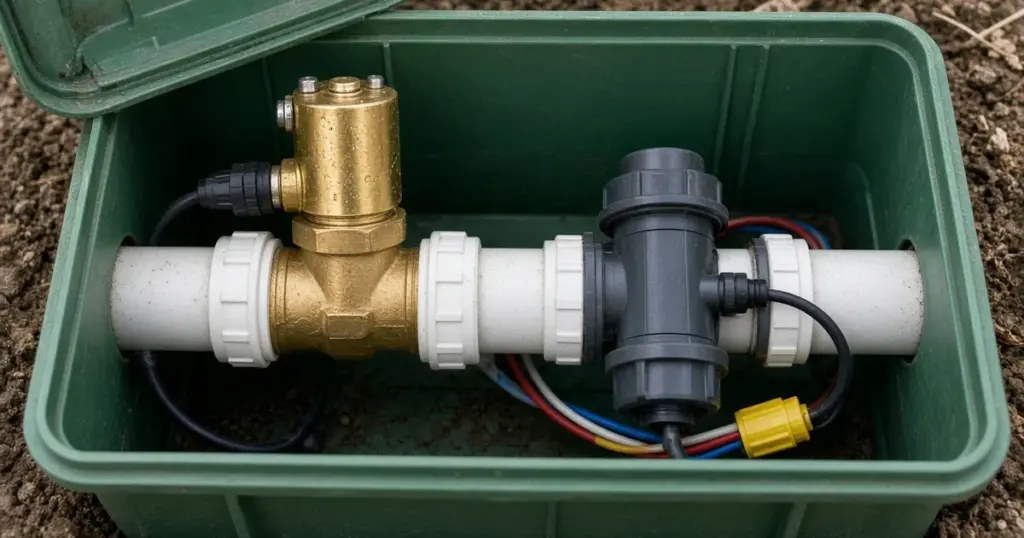
A broken lateral line or a stuck valve can pour water into a yard for hours before anyone notices, especially at night, while you are at work, or when the home is empty. A flow sensor paired with a master valve gives the irrigation system a way to notice that something is wrong and stop it. When flow is higher than expected, or water flows when it should not, the controller can close the master valve, skip the problem zone, and send an alert.
This guide explains how these components work, when they are worth adding, and what installation involves for homes and businesses around Huntsville, TX and Walker County.
What a Master Valve Does
A master valve is an automatic valve installed on the main line, after the backflow assembly and before the zone valves. TCEQ guidance states that when a master valve is installed, it goes on the discharge side of the backflow assembly. The controller opens the master valve only when a zone is scheduled to run. The rest of the time, the main line downstream of it is not pressurized.
That has several benefits:
- Main line leaks lose water only during watering, not around the clock.
- A zone valve that sticks open stops flowing when the master valve closes.
- The controller has a way to shut off all irrigation automatically.
Our article on main line vs. lateral line leaks explains how a master valve changes the way leaks behave.
What a Flow Sensor Does
A flow sensor measures how much water is moving through the irrigation main line. Connected to a compatible controller, it lets the controller:
- Learn normal flow for each zone.
- Detect high flow, which can indicate a broken head or pipe.
- Detect low flow, which can indicate a clogged filter or a valve that did not open fully.
- Detect unscheduled flow, which can indicate a stuck valve or main line leak.
When the controller sees a problem, it can shut the master valve, skip the zone, and send a notification, depending on the model.
Why They Work Best Together
A flow sensor without a master valve can detect a problem but may not be able to stop flow from a stuck valve or a main line break. A master valve without a flow sensor closes between cycles but cannot tell when something is wrong during a cycle. Together, they provide detection and automatic response.
Who Benefits Most
- Part-time or vacation homes, where problems can run unnoticed.
- Rental properties, where tenants may not report leaks.
- Commercial and HOA properties with large systems.
- Homes with long main lines or lines under hardscape.
- Owners who want detailed water use data.
Installation Overview
- Confirm controller compatibility. Not every controller supports flow sensing. Smart controllers often support it with specific sensors. Our walkthrough on replacing an old sprinkler controller covers choosing a compatible model.
- Choose a sensor sized for the main line and expected flow.
- Install the master valve on the main line after the backflow assembly.
- Install the flow sensor in a straight section of pipe, following the manufacturer’s guidance on distance from fittings and valves.
- Run wiring from the sensor and master valve to the controller.
- Program the controller, including learning flow for each zone and setting high- and low-flow limits.
- Test by simulating a high-flow condition, such as removing a nozzle, to confirm the controller responds.
Setting Thresholds
Thresholds that are too tight cause false alarms; too loose, and real problems go unnoticed. Many controllers can learn each zone’s normal flow automatically. After repairs or changes to a zone, relearn its flow.
Maintaining the System
- Keep the filter clean if the system has one, since a clogged filter reduces flow and can trigger low-flow alerts.
- Relearn flows after adding or changing heads.
- Check the master valve periodically for proper opening and closing.
- Review alerts promptly.
Connecting to Smart Controllers
Many smart controllers report flow data in their apps, including alerts and usage history. That only works if the controller stays online. See smart sprinkler controller Wi-Fi problems for tips on keeping it connected. Our existing article on whether smart sprinkler controllers are worth it covers the bigger picture.
Interpreting Common Alerts
| Alert | What it often means | What to check |
|---|---|---|
| High flow | Broken head, cracked pipe, missing nozzle | Walk the zone while it runs |
| Low flow | Clogged filter, partly closed valve, kinked line | Filter, flow control, valve |
| Unscheduled flow | Stuck zone valve, main line leak | Valve boxes, meter, main line |
| No flow | Master valve not opening, supply closed | Master valve, supply, wiring |
When an alert appears, check the zone named in the alert first. If the controller shut the system down, it will usually stay off until the problem is acknowledged or cleared, so fix the cause before restarting.
Limitations
Flow sensing detects problems on the irrigation side downstream of the sensor. It does not detect leaks in the house plumbing or before the sensor. Small leaks may fall below the detection threshold.
When to Call a Pro
Call a professional if you want a master valve and flow sensor added to an existing system, if your controller reports flow alerts you cannot explain, or if you manage multiple properties and want consistent leak protection. A licensed irrigator can size the components, install them correctly, and set thresholds. The controllers and smart irrigation guide covers related technology. We install leak protection for homes and businesses across Huntsville and Walker County. See our irrigation installation page and our services page.
Frequently Asked Questions
Do I need a master valve if I have a flow sensor?
A flow sensor can detect problems, but a master valve lets the controller stop flow automatically. They work best together.
Can a flow sensor detect a slow leak?
It depends on the sensor and settings. Very small leaks may fall below detection thresholds.
Will a master valve affect my water pressure?
A properly sized master valve should have minimal effect on pressure. Sizing it to the system matters.
Add Automatic Leak Protection
If you want a system that catches leaks on its own, call 346-586-6060 or request an estimate.