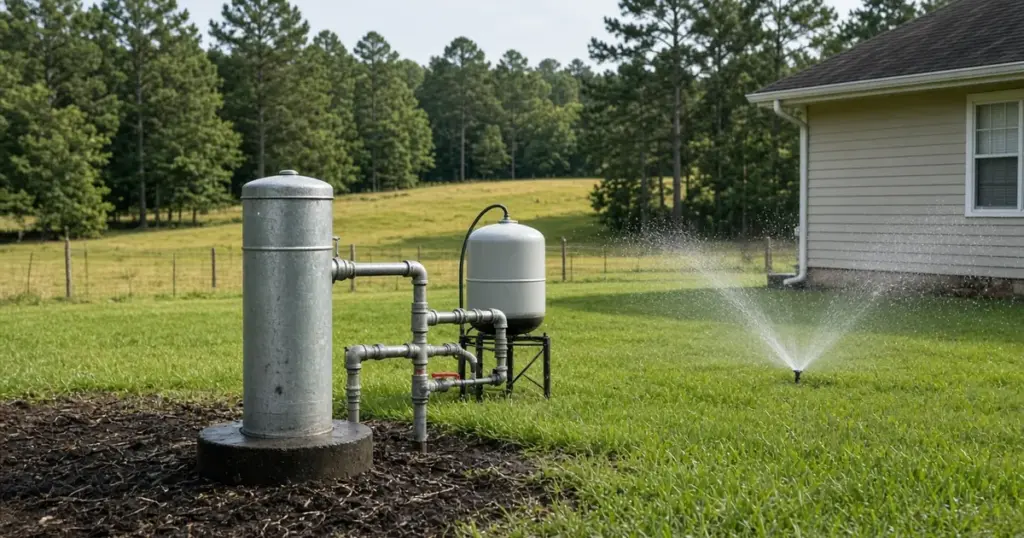
For many rural homeowners in Walker County, running the sprinkler system from a private well seems like an obvious way to save on water bills. Before you drill a new well or connect irrigation to an existing one, it helps to understand the rules that apply. Where your property sits, how the well is used, and how it connects to other water supplies all affect what you need to do.
This guide summarizes the main points to check, with links to official sources. It is general information, not legal advice. Rules change, so confirm requirements with the relevant agency before starting a project.
Inside Huntsville City Limits
The City of Huntsville’s Unified Development Code prohibits irrigation wells within city limits. If your property is inside the city, plan on irrigating from the public water supply rather than a private well.
Groundwater District Registration
Walker County is within the Bluebonnet Groundwater Conservation District, which also covers Austin, Grimes, and Waller counties. The district states that all water wells within its boundaries must be registered with it. Its rules distinguish exempt wells, such as domestic and agricultural wells, from non-exempt uses, which require a permit. Contact the district to confirm how your well and its intended use are classified and what forms apply before drilling or changing a well.
Licensed Drillers and Pump Installers
In Texas, drilling a water well and installing a well pump require licenses issued by the Texas Department of Licensing and Regulation. Hire licensed professionals for well construction and pump work, and ask for the well report when the job is done.
Licensed Irrigators
Irrigation system design and installation for others in Texas is done by or under licensed irrigators under TCEQ rules. Homeowners working on their own property may be exempt from licensing, but Texas Occupations Code Chapter 1903 says exempt work must still meet the state’s standards.
Backflow and Cross-Connections
Well-only systems
If the irrigation system is supplied only by a well and never connects to a public water system, public backflow testing rules for the utility connection do not apply in the same way. But the well itself still needs protection. Contaminants drawn back into a well, especially from fertilizer or chemical injection, can affect the household water supply that the same well serves.
Systems connected to both
Some properties have a well for irrigation and public water for the house, or a system that can switch between them. Any connection between a well-supplied irrigation system and a public water supply is a cross-connection risk. TCEQ’s cross-connection control page explains the program, and your water provider will have requirements. Proper separation or an approved assembly is essential.
Chemical injection
TCEQ guidance treats irrigation systems with chemical additives as a health hazard, which calls for a reduced pressure principle assembly where the system connects to potable water. Even on a well-only system, protect the well from backflow of injected chemicals.
Practical Considerations
Rules are only part of the picture. A well also needs to deliver enough water for the irrigation you plan:
- Pump capacity and pressure tank size determine how many heads a zone can run. Our guide to well pumps, pressure tanks, and sprinkler systems explains how to match zones to the well.
- Water quality affects equipment. Iron can stain surfaces; see iron staining from well water sprinklers.
- Sediment clogs nozzles and valves, so plan for filtration.
- Household needs come first if the same well supplies the house.
Our existing article on well water irrigation systems in Walker County introduces these issues.
Steps Before Starting a Well Irrigation Project
- Confirm your property is outside city limits if you are near Huntsville.
- Contact the groundwater district about registration and permitting.
- Hire a licensed driller and pump installer for well work.
- Have the water tested for iron and other minerals.
- Design the irrigation around the well’s capacity.
- Plan backflow protection for the well and any connection to public water.
- Keep records of the well report, registration, and irrigation design.
Existing Wells on a Property You Buy
If you buy a rural property with an existing well, find out what you can before relying on it for irrigation. Ask the seller for the well report, any registration paperwork, and records of pump replacement or water testing. Have the water tested if you do not have recent results. Check how the irrigation is connected and whether any cross-connection exists with a public water supply. An old, unused well that is not going to be put back into service may need to be properly plugged; the district and TDLR can explain the requirements.
Rural Properties Around the County
Many properties in places like Dodge, Riverside, and New Waverly rely on wells for some or all of their water. The rules above apply across the district; local conditions, like well depth and water quality, vary. Our page on sprinkler repair in Dodge covers rural system issues.
When to Call a Pro
Call a licensed irrigator if you want an irrigation system designed for a well, if your existing well system short cycles or clogs, or if you are unsure whether your well and public water connections are properly separated. For drilling, pump, and registration questions, contact a licensed well professional and the groundwater district. The backflow prevention and testing guide explains protection requirements. We design and repair well-supplied irrigation across Walker County. See our irrigation installation page and our services page.
Frequently Asked Questions
Can I drill a well for my sprinklers in Huntsville?
Not inside city limits. The City of Huntsville’s development code prohibits irrigation wells within the city.
Do I need to register a water well in Walker County?
The Bluebonnet Groundwater Conservation District states that all water wells in its district, which includes Walker County, must be registered.
Does a well-only sprinkler system need backflow protection?
Protecting the well from contamination is still important, especially if chemicals are injected. Any connection to public water requires approved protection.
Plan a Well-Supplied System
For help designing or repairing irrigation on a well, call 346-586-6060 or request a consultation.